Contract Mining Policy in Ghana: What the 30 November Safeguards Mean for Mineworkers
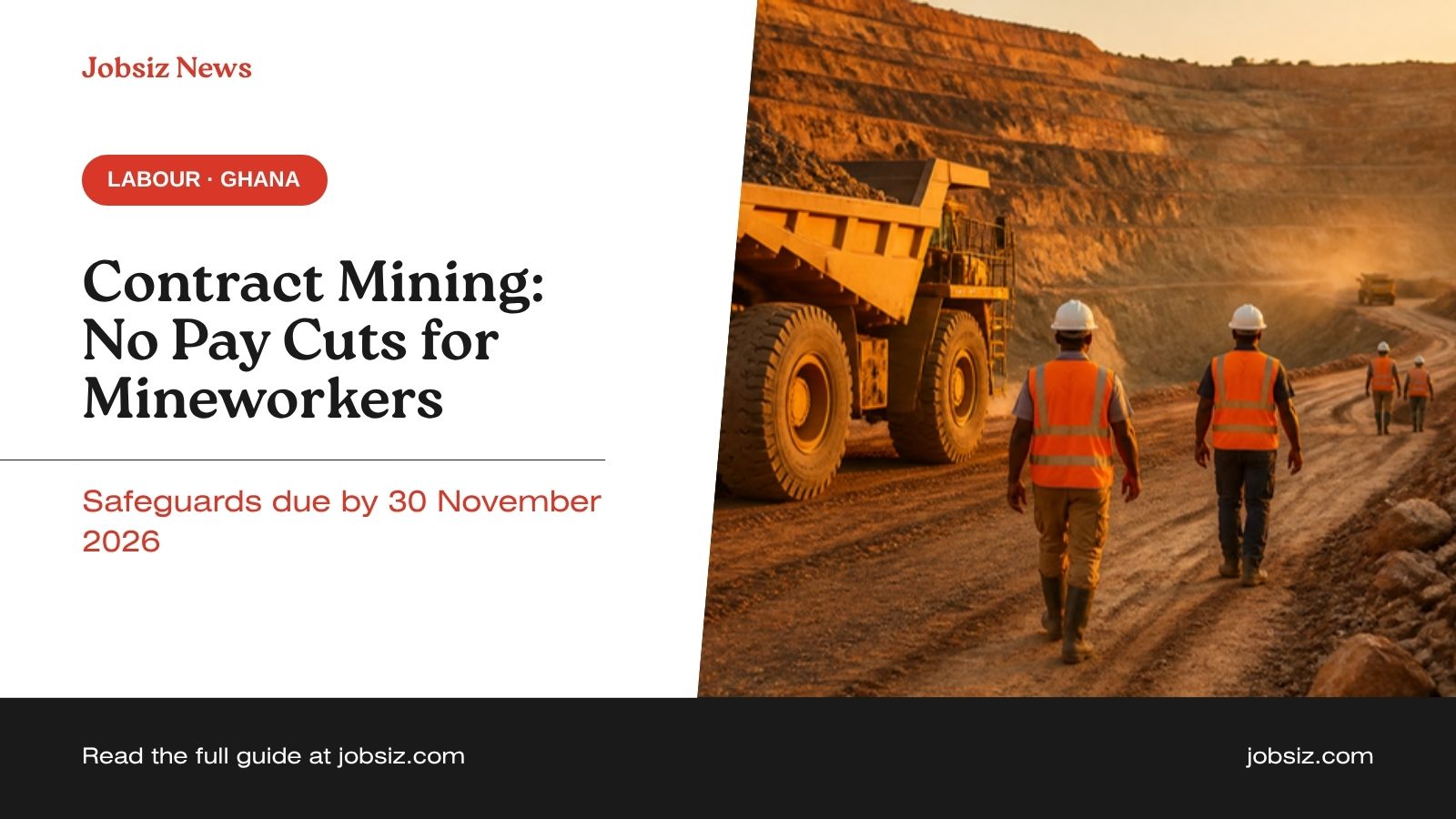
Ghana's government has told the Minerals Commission to make sure no mineworker earns less or loses benefits when a mine moves from owner mining to contract mining, and to finish the paperwork for these safeguards by 30 November 2026. If your job shifts from a mining company to a mining contractor, the official position is that your wages, allowances and conditions of service must stay at least equal to what owner-mine staff were paid for comparable work before the switch.
The new measures were announced on 21 October 2026 by the Ministry of Lands and Natural Resources. Below we explain what the contract mining policy is, what has changed, what it means for current workers and job seekers, and the steps to take if your pay or benefits are cut.
Key facts at a glance
Announced: 21 October 2026, in a statement from the Ministry of Lands and Natural Resources
Deadline: the Minerals Commission must complete the required processes and submit documents for approval by 30 November 2026
Main promise: no worker employed, or to be employed, by a mining contractor should be made worse off in wages, benefits or conditions of service because of the move to contract mining
Who it covers: workers of mining contractors and similar service providers across the mining value chain
Legal basis: the Minerals and Mining (Local Content and Local Participation) Regulations, 2020 (L.I. 2431)
Still to come: the detailed harmonised pay and conditions framework has not yet been published
What is the contract mining policy?
In owner mining, the mining company itself employs the people who drill, blast, load and haul ore. In contract mining, the company hires a separate contractor to do that work, and the contractor employs the workers.
Ghana's local content rules require this work to go to Ghanaian firms:
Surface mining: contract mining must be carried out by indigenous Ghanaian companies.
Underground mining: contract mining must be carried out through a partnership in which a Ghanaian-owned company holds at least a 50% interest.
This requirement sits in the sixth edition of the Local Procurement List, which took effect on 1 January 2025 under L.I. 2431. According to the Ministry, most multinational mining companies in Ghana have already made the transition.
The three new safeguards for mineworkers
No deterioration in pay or conditions. The Minerals Commission must ensure that no worker of a mining contractor or similar service provider suffers any cut in wages, emoluments, entitlements, benefits or conditions of service because of the transition. The Ministry says contract mining workers should receive salaries, allowances, benefits and incentives equivalent to those of owner mining workers doing comparable work before the switch.
Harmonised pay across the industry. The Commission must take steps to harmonise salaries, wages and conditions of service across the mining industry value chain.
Contractors grouped by capacity. Eligible mining contractors will be categorised according to their capacity to provide mining-related services.
The Ministry also said the government will have zero tolerance for unfair labour practices, cartelisation, bid rigging and "fronting" (where a Ghanaian name is used to hide foreign control) that undermine local content or harm Ghanaian workers.
Why the government acted now
The safeguards follow months of pushback from the Ghana Mineworkers' Union (GMWU) of the TUC. In a letter dated 23 April 2026, the union rejected a reported directive for Zijin, Newmont and AngloGold to move their owner mining operations to contract mining by December 2026. It argued that workers who move to contractors often see their pay fall, in its words, by at least half for the same job.
On 20 August 2026 the union petitioned the Minister for Lands and Natural Resources, demanding that the directive be suspended. It said more than 95% of mining workers were now on fixed-term, casual or contract arrangements. It also raised delayed wages, unpaid provident fund and gratuity payments, pension issues and safety. The union warned of protests, starting with red armbands from 1 September.
These are the union's claims; the Ministry's response is that local content must not come at the expense of workers, and the new measures are meant to settle that concern.
What it means for you
If you work directly for a mining company
If your role is being moved to a contractor, the stated policy is that your new pay and benefits should be no lower than those of owner mine staff doing comparable work before the switch.
Ask for the new employer's offer in writing before you accept, and compare it line by line with your current contract and pay slip.
If you already work for a mining contractor
The harmonisation measure could, over time, bring contractor pay and conditions closer to owner mine levels. The details have not been released yet, so do not rely on any figure you see on social media until the Minerals Commission or the Ministry publishes it.
Check that your SSNIT and Tier-2 pension contributions are being paid. You can request your contribution statement from SSNIT.
If you are looking for a mining job
A growing share of mining jobs in Ghana are now with Ghanaian contracting firms, not only with the big mine owners. Search both.
Read the employment contract carefully: who is your employer, how long is the contract, and what allowances and benefits are included?
Browse current mining jobs in Ghana and engineering jobs in Ghana on Jobsiz.
Your rights if your job moves to a contractor
Ghana's Labour Act, 2003 (Act 651) already gives workers protection when a business is restructured. Under section 65, the redundancy rules can apply not only when a job ends, but also when a reorganisation or arrangement leaves a worker with poorer terms and conditions. In that situation:
The employer must give written notice to the Chief Labour Officer and the trade union at least three months before the change takes effect.
The employer must consult the union (or the workers, if they are not unionised) on ways to avoid or reduce job losses and soften the impact.
Redundancy pay and its terms must be negotiated between the employer and the worker or union.
If the two sides cannot agree on redundancy pay, the matter can be referred to the National Labour Commission (NLC).
Practical steps if your pay or benefits are cut:
Keep copies of your old and new contracts, pay slips and any letters about the transfer.
Raise the issue with your union branch or workers' representative first.
If it is not resolved, file a complaint with the National Labour Commission or your regional Labour Department office.
Get independent legal advice for serious disputes. This article is general information, not legal advice.
Avoid mining recruitment scams
Fake mining job offers are common in Ghana. The Minerals Commission has warned that it does not use agents to recruit on its behalf and never charges any fee, down payment or "facilitation" money for employment. Real vacancies are advertised in national newspapers, on official websites and on verified social media pages.
Never pay a "protocol" fee or any money to get a mining job.
Apply only through the company's official careers page or a trusted job board.
Report anyone who asks you for money to the police or to the company concerned.
Before you apply, make sure your CV format is clear and up to date.
What happens next?
By 30 November 2026, the Minerals Commission is expected to submit the documents needed to put the safeguards into effect. Approval and publication of the detailed rules on pay harmonisation and contractor categories should follow. We will update this guide when official details are released.
For the national pay floor that applies to all workers, see our guide to the minimum wage in Ghana 2026.
Frequently asked questions
What is the deadline for the contract mining safeguards in Ghana?
The Minerals Commission must complete the required processes and submit the documents for approval by 30 November 2026.
Will my salary go down if my mine switches to contract mining?
Under the government's new directive, it should not. Workers of mining contractors are to receive pay, allowances and benefits equivalent to those of owner mining workers doing comparable work before the transition.
Who must carry out contract mining in Ghana?
Indigenous Ghanaian companies for surface mining. For underground mining, a partnership in which a Ghanaian-owned company holds at least a 50% interest.
Where can I complain if my mining employer cuts my pay?
Start with your union. If the issue is not resolved, you can take it to the National Labour Commission or the Labour Department.
Do I have to pay to get a job at a mine in Ghana?
No. Genuine recruitment is free. Anyone asking for money to secure a mining job is very likely a scammer.
Sources
MyJoyOnline: Government's 3 new measures to protect mineworkers (21 Oct 2026)
Adomonline: Government sets November 30 deadline for contract mining safeguards (21 Oct 2026)
MyJoyOnline: Ghana Mineworkers Union demands suspension of contract mining directive (21 Aug 2026)
MyJoyOnline: Minerals Commission warns public against fake recruitment agents (28 Aug 2026)
Mondaq: Redundancy under Ghanaian labour law (Labour Act, 2003, Act 651, section 65)
Looking for your next role? Browse the latest jobs in Ghana on Jobsiz and apply directly to verified employers.
Spotted an error or out-of-date detail? Report a correction — we review every report. See our editorial policy.