EPWP Jobs 2026: How to Apply, Who Qualifies and Pay
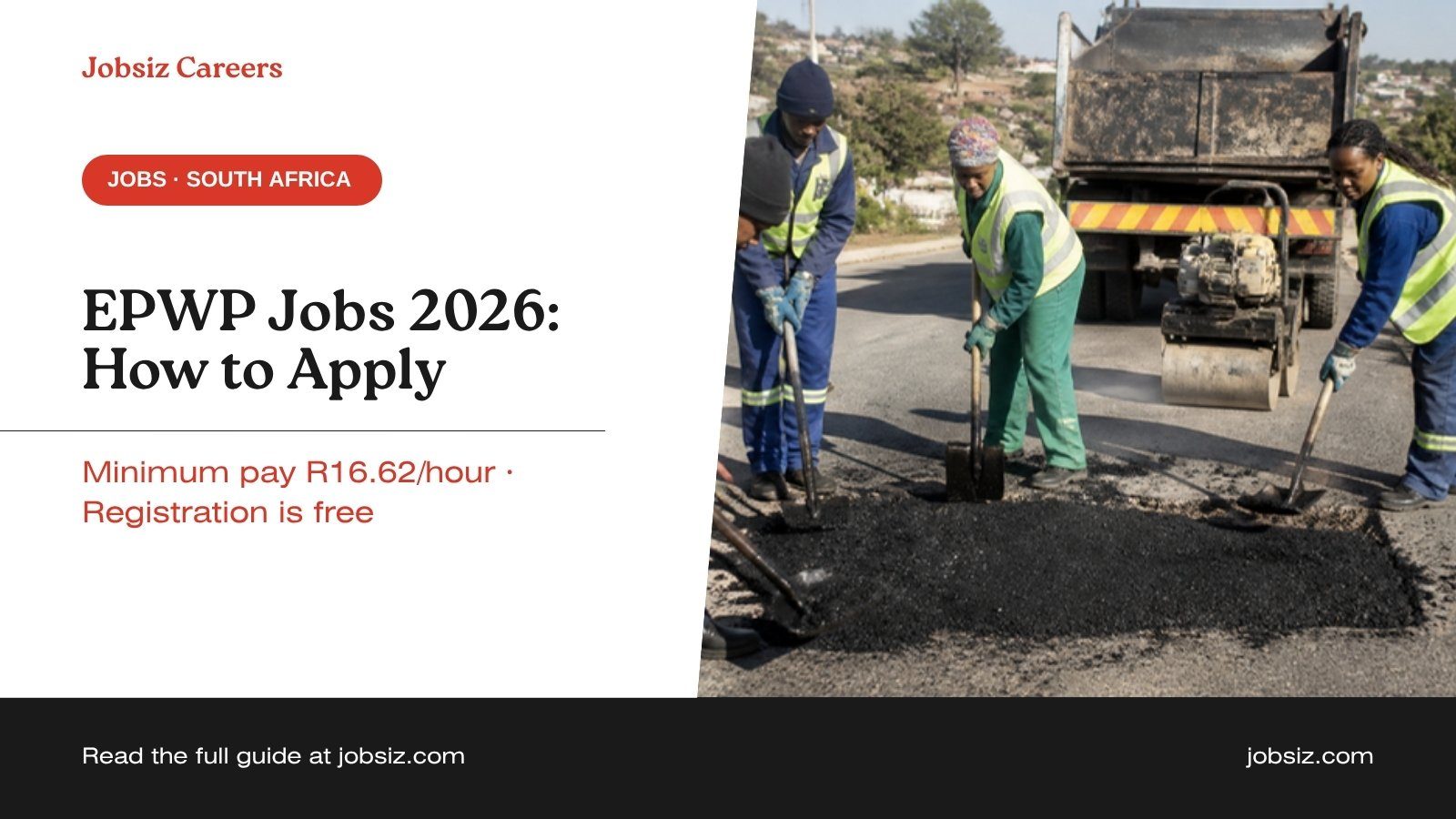
Quick answer: To get an EPWP job in South Africa, you register on the jobseeker or EPWP database run by your local municipality (or the project's implementing department), then wait to be selected when a project in your area needs workers. There is no single national online application and no fee. In 2026, EPWP workers must be paid at least R16.62 an hour, which is a separate, lower rate from the R30.23 national minimum wage.
Key facts at a glance
What it is: the Expanded Public Works Programme (EPWP), described by the Presidency as a nationwide programme that creates work opportunities and income support for poor and unemployed people.
Who runs it: the Department of Public Works and Infrastructure (DPWI) leads the programme, while municipalities and other public bodies run the projects and do the hiring.
Current phase: Phase V, approved by Cabinet in February 2024, runs from April 2024 to March 2029 and aims to create five million work opportunities, with an estimated five-year budget of R178 billion.
Minimum pay in 2026: R16.62 per hour, up from R15.16.
Cost to apply: nothing. Anyone asking you to pay for an EPWP placement is a scammer.
What kind of work do EPWP projects offer?
EPWP jobs are hands-on, community-based work opportunities rather than permanent posts. According to government statements about Phase V, projects focus on:
Road maintenance, including pothole patching and road paving
Waste management, with recycling as a major focus
Maintaining public buildings, facilities and other public infrastructure
Cleaning and beautifying public spaces such as parks and streets
Social services projects in communities
Most EPWP opportunities are for a fixed, limited period. Your contract should tell you the start date, end date, working hours and daily or hourly rate, so read it carefully before you sign.
Who qualifies for EPWP jobs?
The programme is aimed at poor and unemployed South Africans, and government has said Phase V will be intensified to reach youth, women and rural communities. You usually do not need matric or work experience, which makes EPWP one of the few routes into paid work for people starting from zero.
Each project sets its own selection rules, so requirements differ between municipalities. In practice, expect to need:
A South African ID (some municipalities, such as the City of Cape Town, also accept a valid South African work permit)
A short CV, even a one-page one
Proof that you live in the ward or area where the project is running, if the municipality asks for it
To be unemployed at the time you are selected
How to apply for EPWP jobs: step by step
Find your municipality's EPWP or jobseeker database. Check your municipality's website or call its main switchboard and ask for the EPWP office. In big metros, registration is often done at a local office; the City of Cape Town, for example, registers jobseekers at sub-council offices.
Take your documents. Bring your ID (or valid work permit) and a CV. If you need help with the CV, follow our South African CV format guide.
Register and keep proof. Ask for a reference number or a stamped copy of your registration so you can follow up later.
Keep your contact details up to date. Selection can happen months after you register. If your phone number changes, update it with the EPWP office, otherwise you may miss the call.
Wait for selection. Many municipalities select workers from the database when a project starts. Cape Town says its EPWP workers are randomly selected from its jobseekers' database, which is meant to stop favouritism.
Check any offer before you accept it. A genuine call will come from the municipality or project team, will name the project and will never ask you for money.
While you wait, it is worth registering on the Department of Employment and Labour's jobs platform too. Our guide on how to register on ESSA explains how.
How much do EPWP workers earn in 2026?
EPWP workers are covered by a special dispensation under the national minimum wage system, so they have their own floor. When government announced the 2026 minimum wage increase in February 2026, it set the EPWP rate at R16.62 per hour, up from R15.16. The general national minimum wage rose to R30.23 per hour from 1 March 2026.
Based on Jobsiz calculations at the minimum EPWP rate:
An 8-hour day: at least R132.96
A 40-hour week: at least R664.80
A month: depends on how many days the project gives you, so check your contract
These are minimums. Your contract may state a daily rate rather than an hourly one; either way, it should not work out below the legal EPWP minimum. For more on pay floors, see our minimum wage guide for 2026.
EPWP job scams: how to protect yourself
Fake EPWP adverts spread quickly on WhatsApp and Facebook. Municipalities have warned about messages promising monthly stipends of R7,000 to R20,000 and about people posing as EPWP staff who demand money to "add you to the list". Protect yourself with these rules:
Never pay. The City of Cape Town and George Municipality both say they will never ask for payment for an EPWP job, and DPWI has said government never requests payment for jobs.
Check the email address. DPWI says official government links and emails end in "gov.za", not ".org" or a Gmail address.
Be wary of big promises. A stipend far above the legal EPWP rate, or a "guaranteed" placement, is a warning sign.
Verify with the municipality. Phone the EPWP office using the number on the official municipal website, not the number in the message.
Our article on the R15,000 WhatsApp recruitment scam shows how these fake adverts usually work.
EPWP vs other entry-level options
EPWP is a useful first step, but it is temporary. Use the time to build experience and look at longer-term routes as well:
Frequently asked questions
Can I apply for EPWP jobs online?
There is no single national online EPWP application. You register with your municipality or the department running a project in your area. Some municipalities may offer online forms, so check your own municipality's official website.
Do I need matric for an EPWP job?
Usually not. Most EPWP work is general or community-based work with no formal qualification required, but individual projects can set their own requirements.
What is the EPWP rate per hour in 2026?
The minimum EPWP rate is R16.62 per hour, announced in February 2026 alongside the national minimum wage increase to R30.23. That works out to at least R132.96 for an 8-hour day.
Is EPWP a permanent job?
No. EPWP offers temporary work opportunities on specific projects. Your contract will state how long the work lasts.
Do I have to pay to be added to the EPWP database?
No. Registration is free. Anyone who asks for money, airtime or a "uniform fee" to place you on an EPWP project is running a scam, and you should report it to your municipality.
Find work near you
EPWP is one option among many. Browse the latest jobs in South Africa on Jobsiz and set up alerts so new entry-level vacancies reach you first.
Sources
SAnews: National Minimum Wage to rise to R30.23 per hour from March (4 February 2026)
SAnews: Government boosts initiatives to tackle youth unemployment (12 September 2025)
SAnews: DPWI to accelerate EPWP work opportunities (31 October 2024)
gov.za: Public Works and Infrastructure accelerates EPWP (30 October 2024)
gov.za: Public Works and Infrastructure warns public about scammers
Updated 29 October 2026 by the Jobsiz Editorial Team. Pay rates and programme details can change; always confirm with your municipality's EPWP office.
Spotted an error or out-of-date detail? Report a correction — we review every report. See our editorial policy.