EU Pay Transparency Directive: What Job Seekers Gain in 2026
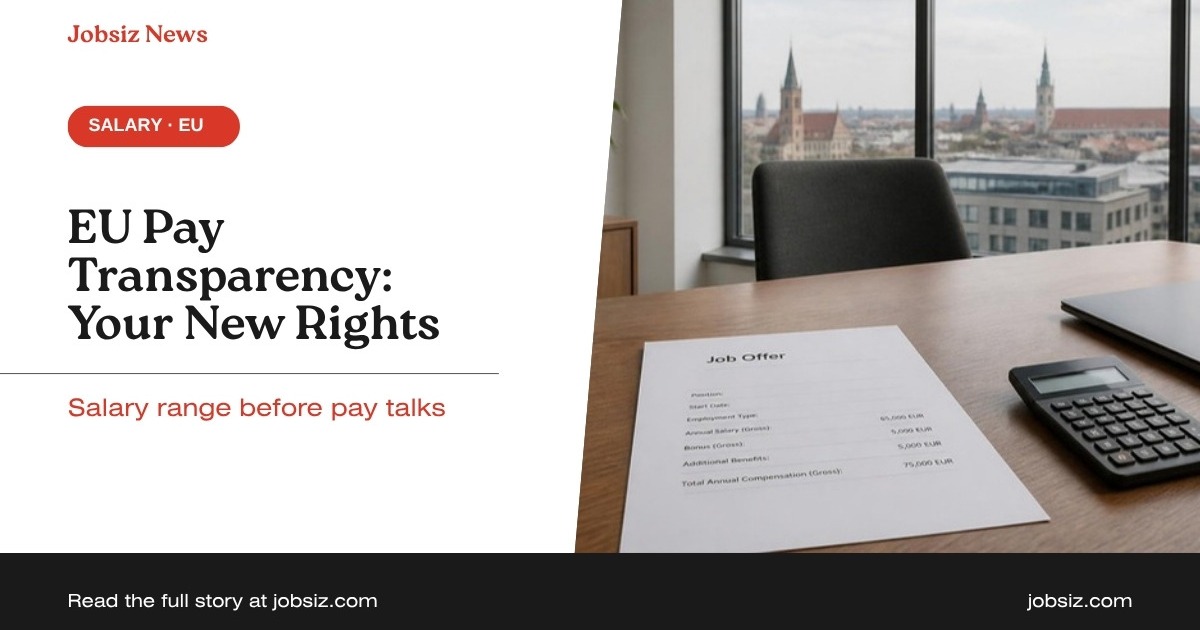
Quick answer: The EU pay transparency directive (Directive (EU) 2023/970) gives job applicants the right to learn the starting pay or pay range before pay talks, for example in the advert, and stops employers asking about past pay. Countries had to apply it by 7 June 2026; only five had fully done so by 23 September 2026, according to Lockton.
Key takeaways
Under the EU pay transparency directive, applicants can receive the initial pay or pay range for a job before pay negotiations, for example in the published vacancy notice or before the interview.
Employers covered by the directive may not ask candidates about their pay history in current or previous jobs.
Once hired, workers can request, and receive in writing, their own pay level and the average pay, split by sex, for colleagues doing the same work or work of equal value, with a reply due within two months.
The national deadline was 7 June 2026, yet as of 23 September 2026 only Greece, Italy, Lithuania, Malta and Slovakia had fully transposed it, according to Lockton.
Your rights depend on your country's national law, so check whether the member state where you are applying has passed its own rules.
Last updated: 7 October 2026
If you are applying for jobs in the European Union, the EU pay transparency directive is changing what an employer must tell you before you sign. Adopted as Directive (EU) 2023/970, it sets minimum rules on pay openness for employers in both the public and private sectors, and it gives applicants specific rights from the very first stage of recruitment. Member states were required to bring it into national law by 7 June 2026. Progress has been patchy, so what you can expect today depends heavily on the country where the job is based.
What is the EU pay transparency directive?
It is an EU law that strengthens the principle of equal pay for women and men doing equal work or work of equal value, using pay transparency and tougher enforcement. It does not set salaries; instead it obliges employers to disclose pay information and gives workers routes to enforce equal pay.
The directive covers anyone with an employment contract or employment relationship under national law, and its pre-hiring rule explicitly extends to people applying for work. As a directive, it binds the 27 member states, which must each pass their own legislation to put it into effect.
What rights do job seekers get before they are hired?
Applicants get three main protections: a right to pay information up front, a ban on pay-history questions, and a requirement for gender-neutral, non-discriminatory recruitment. These sit in Article 5 of the directive.
Pay information before you negotiate: the prospective employer must tell you the initial pay, or its range, for the position. It must be based on objective, gender-neutral criteria.
Collective agreement terms: where a collective agreement applies to the role, you are entitled to the relevant provisions.
Timing: the information must arrive in a way that allows informed and transparent negotiation, such as in the published job advert, before the interview or by another route.
No pay-history questions: an employer must not ask what you earn now or earned in earlier jobs.
Neutral adverts: vacancy notices and job titles must be gender-neutral.
Note what the text does not say. It does not force every employer to print a salary in the advert itself; the advert is one listed option among others. Poland is a useful example. According to Trusaic, Polish rules in force since 24 December 2025 let employers share the range at any point in recruitment, as long as negotiation stays informed, and they prohibit questions about salary history.
What changes once you start the job?
After hiring, you gain a right to request pay data and protection when you discuss your own salary. Employers must also make their pay-setting criteria accessible.
Right to information (Article 7): you can request, and receive in writing, your own pay level, together with average pay for women and men in the worker categories that do the same work as you or work of equal value. You can ask directly, through workers' representatives or through an equality body.
A firm deadline: the employer must answer within a reasonable period and no later than two months after your request.
An annual reminder: employers must tell all staff every year about this right and how to use it.
No pay secrecy clauses: contract terms that stop you disclosing your own pay for equal-pay purposes must be prohibited.
Clear criteria (Article 6): the criteria for pay, pay levels and progression must be easy for staff to access. Countries may exempt employers with fewer than 50 workers from the progression part.
Which EU countries have applied the directive so far?
Only a minority had finished the job by late September 2026. A status table published by Lockton, reflecting the position on 23 September 2026, groups the 27 member states roughly as follows.
Fully transposed: Greece (Law 5316/2026, in force since 6 July 2026, with most employer duties starting 1 November 2026), Italy (Legislative Decree No. 96/2026, in force since 7 June 2026), Lithuania (Law No. XV-969, most provisions from 7 June 2026 and pay reporting from 1 January 2027), Malta (Legal Notice 173 of 2026, in force since 5 June 2026) and Slovakia (Equal Pay Act, in force since 7 June 2026).
Partially transposed: Estonia, whose mostly pre-employment changes took effect on 13 July 2026, and Poland, whose pre-employment changes took effect on 24 December 2025.
Draft laws targeting 1 January 2027: Czechia, Denmark, Finland and the Netherlands.
Draft published, no date fixed in the table: Bulgaria, Cyprus, France, Ireland (draft covering pre-employment provisions only, published 15 January 2025), Latvia, Portugal, Romania and Spain.
No published draft: Austria, Belgium, Croatia, Germany (a draft has been prepared but not yet published), Hungary, Luxembourg and Slovenia.
Seeking delay: Sweden, where the government said on 26 March 2026 that it would seek postponement and renegotiation.
Positions move quickly, so treat this as a snapshot rather than a final list and check the latest national announcements before relying on it.
Can you rely on the directive if your country is late?
Usually not directly against a private company. Trusaic points out that EU directives have no horizontal direct effect, so an individual generally cannot enforce the text against a private employer until national law exists.
There are two caveats. First, national courts are expected to read existing equal-pay law in line with the directive after the deadline. Second, staff of public bodies may, in some conditions, be able to rely on clear and unconditional provisions directly. If you work for a state employer in a country that has not yet acted, specialist advice may be worth seeking.
When will employers publish gender pay gap reports?
Reporting starts in 2027 for larger employers and is phased by headcount under Article 9. Each report covers the previous calendar year.
250 or more workers: first report by 7 June 2027, then every year.
150 to 249 workers: first report by 7 June 2027, then every three years.
100 to 149 workers: first report by 7 June 2031, then every three years.
If a report shows an average pay difference of at least 5% in any category of workers that the employer cannot justify on objective, gender-neutral grounds, and it is not fixed within six months, the employer must carry out a joint pay assessment with workers' representatives.
What this means for you
For anyone job hunting in Europe, the practical gain is bargaining power. Here is a short checklist to use the new rules well.
Check whether the country where the job is based has transposed the rules, and which parts are already in force.
If no range appears in the advert, ask for it politely before the interview stage.
Decline to give your current salary if asked in a country where the ban applies; you can state your expected range instead.
Once employed, keep a copy of any written pay-information request and note the date, because the two-month clock starts then.
If you believe you are paid unfairly, contact your national equality body or a trade union for guidance.
Common mistakes to avoid
Assuming every advert must show a salary. The directive allows other routes, provided you have the information before negotiating.
Treating the EU deadline as proof that rules apply everywhere. National law decides when your rights begin.
Forgetting that "pay" is broad. The directive defines it to include basic pay plus other cash or in-kind benefits, so ask about bonuses and benefits too.
If you do end up in a dispute, the directive strengthens your position. In a pay discrimination case where the employer has not met its transparency duties, it must prove there was no discrimination, unless the breach was manifestly unintentional and minor, and compensation must include full recovery of back pay with no fixed upper limit. National time limits for equal-pay claims must be at least three years.
Frequently asked questions
Do employers in the EU have to show the salary in job adverts?
Not necessarily. The directive requires the starting pay or range to be shared so you can negotiate on an informed basis, and the published advert is only one of the options listed. It can also come before the interview or in another way, depending on national rules.
Can an employer ask about my current salary in Europe?
Under the directive, no: employers must not ask applicants about pay history from current or previous jobs. The ban becomes enforceable through national law, so check whether your country has transposed it. Poland, for instance, already bans salary-history questions, while Estonia has brought in some, mostly pre-employment, provisions.
When do the EU pay transparency rules have to apply?
The directive was adopted in 2023, and member states had to transpose it by 7 June 2026. By 23 September 2026, Greece, Italy, Lithuania, Malta and Slovakia had fully transposed it, while several others, including the Netherlands, were aiming for 1 January 2027.
Does the pay transparency directive apply in Germany yet?
Not yet. Lockton's 23 September 2026 update says a German draft law had been prepared but not published. Until a national law is passed, the directive cannot normally be enforced against private employers in Germany.
How long does an employer have to answer a pay information request?
A reasonable period, and at the latest two months from the date of your request. National laws can set shorter limits; Trusaic reports that Malta requires a reply within eight days.
Does the directive apply to small companies?
Yes, the pre-hiring rights and the right to information apply regardless of employer size. Under the directive itself, gender pay gap reporting is mandatory only for employers with 100 or more workers, though countries may go further, and countries may exempt those with fewer than 50 from publishing pay progression criteria.
Sources
EU Pay Transparency Directive implementation status (23 September 2026) – Lockton
EU Pay Transparency Directive: who transposed, who delayed, the risks – Trusaic
This article was compiled by Jobsiz from the sources listed above, with AI-assisted writing and automated fact-checking. Published 7 October 2026. We update stories when new verified information becomes available.