Job Interview Questions in South Africa: How to Answer (2026)
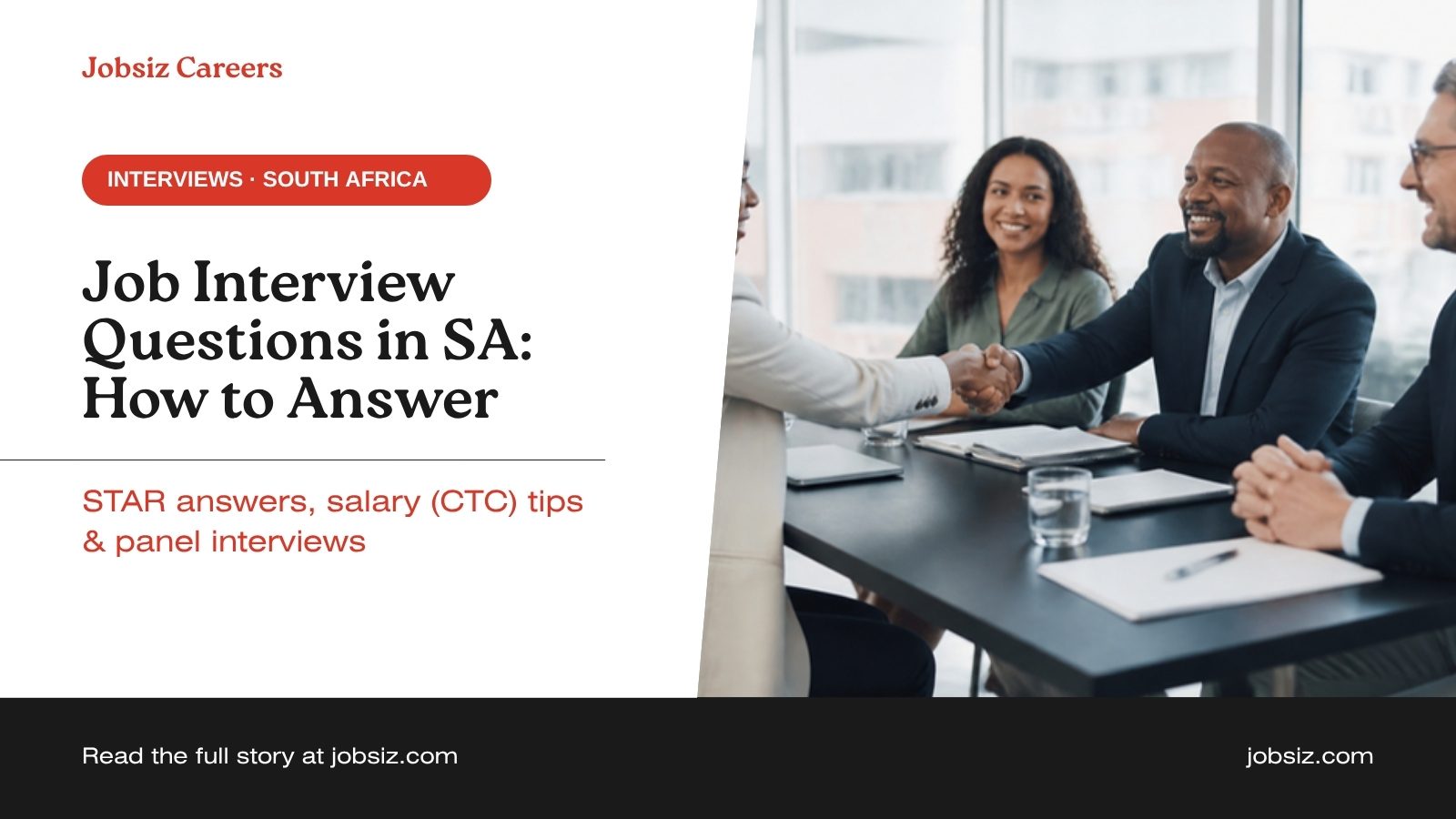
The job interview questions you are most likely to face in South Africa are "Tell me about yourself", "Why do you want to work here?", "What are your strengths and weaknesses?", "Tell me about a problem you solved" and "What are your salary expectations?". The best answers are short (about one to two minutes), use a real example from work, school, a learnership or volunteering, and link back to the job advert. For government posts, expect a panel interview with competency-based questions, plus a practical exercise and an integrity assessment if you are shortlisted.
Key takeaways
Prepare five or six real stories you can use for many different questions (a problem you solved, a mistake you fixed, a time you worked under pressure, a time you led or helped a team).
Use the STAR method (Situation, Task, Action, Result) for "Tell me about a time…" questions.
Know whether a salary figure is basic pay or cost to company (CTC) before you name a number.
In the public service, shortlisted candidates may face a practical exercise, an integrity (ethical conduct) assessment, and security and reference checks, including social media.
Under the Employment Equity Act, job applicants are protected against unfair discrimination, and HIV testing is not allowed unless the Labour Court approves it.
What to expect in a South African job interview
Most private-sector employers run one to three rounds. A recruiter or HR officer often does a short phone or video screening first (Microsoft Teams, Google Meet or WhatsApp video are common), followed by a face-to-face or online interview with the hiring manager. Larger companies, banks and retailers may add an online assessment, a typing or numeracy test, or a case study.
Government departments, municipalities and state-owned entities usually use a panel interview: three to five people take turns asking set questions and score each answer against the job requirements. Every candidate gets the same questions, so clear, structured answers matter more than charm.
The most common interview questions and how to answer them
1. "Tell me about yourself"
This is not a request for your life story. Give a 60–90 second summary: who you are professionally, your most relevant experience or studies, and why you applied for this role.
Example: "I completed my matric in 2024 and a 12-month retail learnership at a national supermarket chain, where I worked on tills, stock counts and customer queries. I was trusted to cash up at the end of shifts and helped cut till variances in my section. I'm applying for this sales assistant post because I want to grow into a supervisor role, and your store's training programme fits that goal."
For more versions of this answer, see our guide to answering "Tell me about yourself".
2. "What do you know about our company?"
Spend 20 minutes on the employer's website, recent news and social media pages before the interview. Mention one or two specific facts (a product, a branch expansion, a community programme, the department's mandate) and connect them to why you want to work there.
3. "Why should we hire you?"
Pick the two or three requirements from the advert that matter most and give proof for each. Avoid general claims like "I'm a hard worker" without an example.
4. "What are your strengths?"
Choose strengths that the job actually needs (reliability, accuracy, customer service, numeracy, a driver's licence, a language the customers speak) and back each one with a short example.
5. "What is your greatest weakness?"
Name a real but manageable weakness and show what you are doing about it. For example: "I used to struggle with Excel formulas, so I completed a free online course and now use spreadsheets to track my weekly targets." Do not pick something that is central to the job.
6. "Tell me about a challenge or problem you solved"
Use the STAR method (explained below). Keep the focus on what you did and the result, ideally with a number: time saved, complaints reduced, stock losses cut, marks improved.
7. "How do you handle pressure or a difficult customer?"
Describe a real situation: what happened, how you stayed calm, the steps you took and how it ended. Mention when you escalated to a supervisor, as this shows good judgement.
8. "Why are you leaving your current job?" or "Why is there a gap in your CV?"
Stay honest and positive. Never criticise a previous employer. Gaps are common in South Africa's job market; explain what you did in that time (studying, caring for family, piece jobs, volunteering, a short course) and why you are ready now.
9. "Where do you see yourself in five years?"
Show ambition that fits the organisation, such as moving into a senior, supervisory or specialist role, or completing a qualification related to the job.
10. "What are your salary expectations?"
This is the question South African candidates find hardest. See the next section.
11. "When can you start?"
If you are employed, give your real notice period. Under the Basic Conditions of Employment Act, the minimum notice period is one week in the first six months, two weeks after six months, and four weeks after one year (four weeks after six months for farm and domestic workers), unless your contract sets a longer period. Check your own contract before answering.
12. "Do you have any questions for us?"
Always say yes. Good questions are listed further down.
How to answer the salary question (basic pay vs CTC)
Many South African job adverts and offers are quoted as cost to company (CTC). CTC is the total amount the employer spends on you. Depending on the employer, it may include basic salary, retirement fund contributions, medical aid, allowances and bonuses. Your take-home pay will be lower than your CTC once PAYE tax, UIF and any other deductions are taken off.
Research the range first. Look at similar adverts and salary guides. Government adverts state the salary for each post, usually as an annual package or notch.
Give a range, not one figure. For example: "Based on the responsibilities and the market, I'm looking for between R18,000 and R21,000 a month."
Say whether it is basic or CTC. Ask: "Is the budget for this role quoted as basic salary or cost to company?"
Do not go below the legal floor. The national minimum wage applies to most workers; see our South Africa minimum wage guide.
Keep it flexible. End with: "I'm open to discussing the full package, including benefits and training."
Government and public-service interviews
Public-service posts are advertised in the DPSA vacancy circulars and on department and provincial websites. Applications usually need a completed Z83 form and a detailed CV. If you are shortlisted, expect more than a normal interview. For example, the Department of Agriculture's adverts in DPSA Circular 36 of 2026 state that:
all shortlisted candidates, including senior managers, will do two pre-entry assessments: a practical exercise and an integrity (ethical conduct) assessment;
shortlisted candidates will go through personnel suitability checks, security vetting and reference checks, including social media profiles;
applicants must declare any pending criminal, disciplinary or other allegations or investigations;
senior management (SMS) appointments depend on completing the Nyukela pre-entry certificate from the National School of Government;
if you have not heard back within three months, you should treat your application as unsuccessful.
Rules can differ slightly between departments, so always read the notes on the specific advert.
How to prepare for a panel interview:
Print the advert and highlight every duty and competency listed. Panel questions are usually built from these.
Prepare a STAR example for each key competency (for example, client focus, planning and organising, problem solving, communication, teamwork).
Know the department's mandate and the Batho Pele principles of public service delivery.
Make eye contact with the whole panel, not only the person who asked the question.
Bring your original ID and qualifications in case the panel wants to see them, along with any certified copies the department requests.
The STAR method, with an example
Competency-based questions start with phrases such as "Tell me about a time…" or "Give an example of…". Answer in four steps:
Situation: set the scene in one or two sentences.
Task: what you were responsible for.
Action: the specific steps you took. This should be the longest part.
Result: the outcome, ideally measurable, and what you learned.
Example question: "Tell me about a time you dealt with an angry client."
Example answer: "At the clinic reception where I did my internship, a patient was upset because his file could not be found and he had waited three hours (Situation). I had to calm him down and get him seen (Task). I apologised, explained the delay without blaming colleagues, checked the archive register myself, found his file misfiled under his surname's alternative spelling, and asked the sister on duty to prioritise him (Action). He was seen within 20 minutes and thanked us, and I suggested we file by ID number as well as surname, which the facility manager adopted (Result)."
Questions employers should not ask, and how to respond
The Employment Equity Act prohibits unfair discrimination, directly or indirectly, on grounds including race, gender, sex, pregnancy, marital status, family responsibility, ethnic or social origin, colour, sexual orientation, age, disability, religion, HIV status, conscience, belief, political opinion, culture, language, birth or any other arbitrary ground. Section 9 of the Act makes it clear that these protections cover applicants for employment, not only people already employed.
The Act also says:
Medical testing is prohibited unless legislation allows or requires it, or it is justifiable for reasons such as the inherent requirements of the job.
HIV testing is prohibited unless the Labour Court has ruled that it is justifiable.
Psychological tests and similar assessments must be scientifically shown to be valid and reliable, able to be applied fairly to everyone, not biased against any person or group, and certified by the Health Professions Council of South Africa (or another body authorised by law).
If you are asked something like "Are you planning to have children?" or "What church do you go to?", you can redirect politely: "I can assure you that nothing in my personal life will affect my ability to meet the requirements of this role." If you think you have been treated unfairly, write down what was asked and by whom, and seek advice from the Department of Employment and Labour or a labour lawyer. This guide is general information, not legal advice.
Interview checklist: what to bring
Your ID (smart card or green ID book) and, for driving posts, your driver's licence
Several printed copies of your CV (update it with our free CV builder)
Copies of your matric certificate, qualifications and any certificates asked for in the advert
A pen and a small notebook with your prepared examples and questions
Airtime or data and enough money for transport there and back. Plan to arrive 15 minutes early, allowing for power cuts, taxi delays or traffic.
For online interviews: a charged phone or laptop, a quiet spot, a plain background, and a test call the day before
Good questions to ask the interviewer
What would a successful first three months in this role look like?
What training or development does the organisation offer?
How is performance measured in this position?
What are the biggest challenges facing the team right now?
What are the next steps, and when can I expect to hear back?
After the interview
Send a short thank-you email or WhatsApp message (if that is how the recruiter contacted you) within 24 hours. Repeat your interest and one strength.
Write down the questions you were asked while you still remember them, so you can prepare better next time.
Follow up once, politely, if the deadline they gave has passed.
Watch for scams. Real employers in South Africa do not ask you to pay for an interview, a uniform or a "placement fee".
Frequently asked questions
How long should my interview answers be?
Aim for one to two minutes for most answers. Competency-based (STAR) answers can run to about two or three minutes. If the interviewer wants more detail, they will ask a follow-up question.
What should I wear to a job interview in South Africa?
Dress one level smarter than the people already doing the job. For office and government posts, wear neat formal or smart-casual clothes. For retail, hospitality or trades roles, clean, ironed smart-casual clothes and closed shoes are usually fine.
Is cost to company the same as my take-home pay?
No. CTC is everything the employer spends on you, which can include retirement fund contributions, medical aid and allowances. Your take-home pay is what is left after tax, UIF and other deductions, so it will be lower.
Can an employer test me for HIV before hiring me?
Not unless the Labour Court has ruled that the testing is justifiable. The Employment Equity Act prohibits HIV testing of employees, and section 9 extends this protection to job applicants.
How long does it take to hear back after a government interview?
It varies by department. Many DPSA adverts say that if you have not been contacted within three months of the closing date, you should treat your application as unsuccessful.
Find your next interview
Ready to put this into practice? Browse the latest jobs in South Africa, look at internships in South Africa, or start with our guide to jobs with matric and no experience.
Sources
DPSA Public Service Vacancy Circular 36 of 2026, Annexure A (Department of Agriculture)
Employment Equity Act 55 of 1998 (sections 6–9), SAFLII Law Library
Basic Conditions of Employment Act, section 37 (notice periods), SAFLII Law Library
Updated 25 October 2026 by the Jobsiz Editorial Team.
Spotted an error or out-of-date detail? Report a correction — we review every report. See our editorial policy.