Mining Jobs in South Africa: How to Apply (2026 Guide)
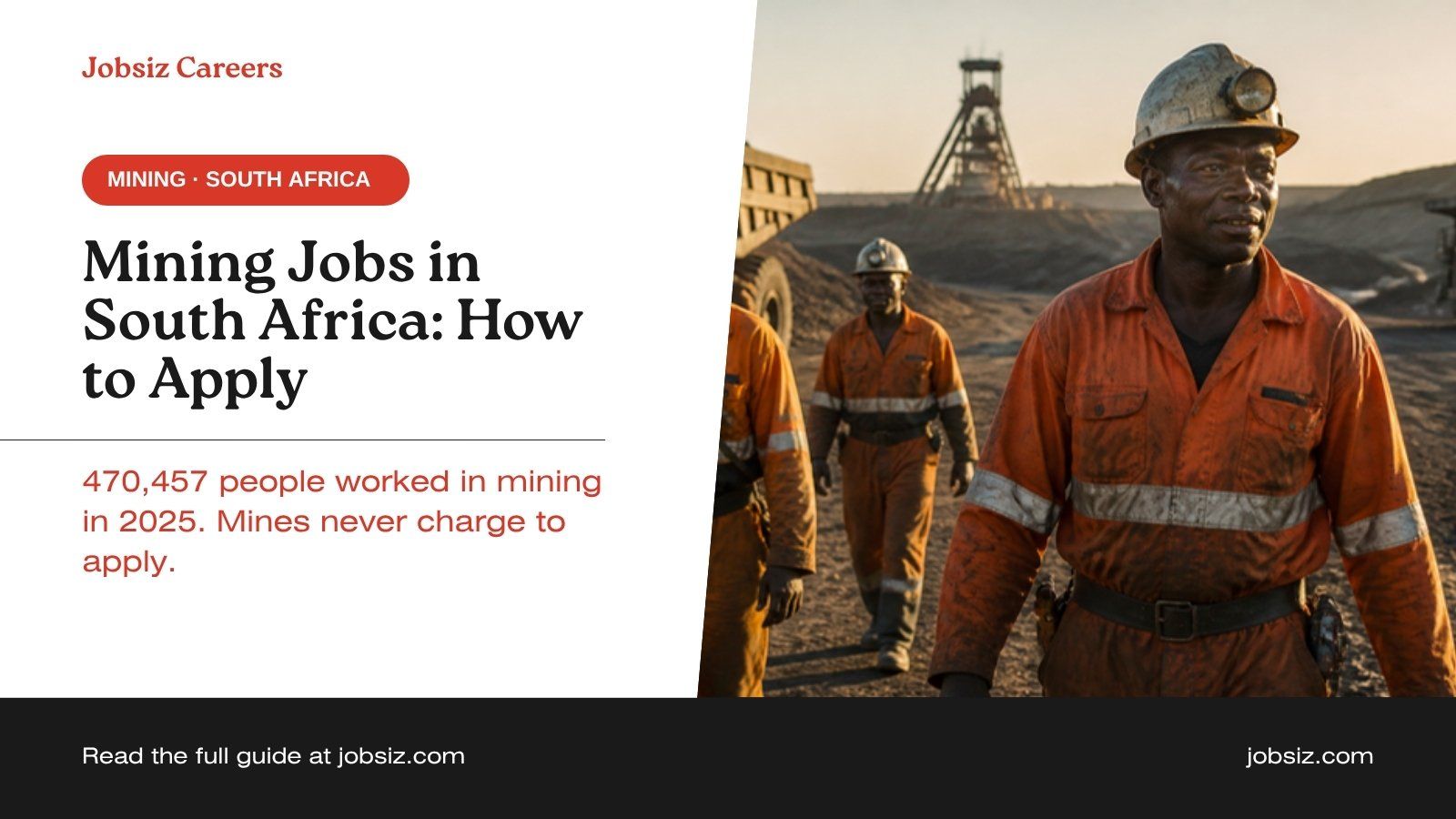
To get a mining job in South Africa, apply only through a mine's own careers or community portal (or a recruiter the mine names on its website), keep your ID, matric certificate and CV ready, and expect a pre-employment medical. Genuine mines never charge you to apply. Mining employed about 470,457 people in 2025, according to the Minerals Council South Africa, so hiring never stops completely, but the honest route in is through official channels, learnerships and community recruitment, not "agents" on WhatsApp.
This guide explains where mining jobs are, what you need, how the main employers recruit and how to tell a real vacancy from a scam.
How big is mining employment in South Africa?
The Minerals Council's annual review, reported in May 2026, says the sector employed 470,457 people in 2025 and paid about R200 billion in wages. Mining added roughly R477 billion to GDP. That makes it one of the larger formal employers outside government, and many of its jobs are in rural towns where other work is scarce.
It is still a competitive market. Many mines fill entry-level posts from nearby communities first, and some vacancies close within days. Applying early and through the right portal matters more than sending your CV everywhere.
Where the mining jobs are
Different minerals are mined in different provinces, so the employers you target depend on where you live or can relocate to:
Platinum group metals: North West (around Rustenburg) and Limpopo. Implats runs its Impala Rustenburg operation here.
Gold: Free State, Gauteng (West Rand) and North West. Harmony runs underground and surface operations across these three provinces.
Coal: Mpumalanga and Limpopo. Exxaro's coal mines include Grootegeluk in Limpopo and Matla, Belfast and Leeuwpan in Mpumalanga.
Iron ore and manganese: mainly the Northern Cape, where Kumba Iron Ore operates.
If you live in a town near a mine, check whether that mine has a separate community recruitment page. Mines usually give local residents priority for some roles.
Types of mining jobs and what they ask for
Requirements differ by company and post, so always read the advert. As a general guide:
Entry-level and general work (general worker, cleaner, helper): often Grade 12 (matric), sometimes lower. You must pass the medical and be willing to work shifts, sometimes underground.
Learner miner and other learnerships: usually matric, often with Maths or Maths Literacy and Physical Science. These are training programmes with a learner allowance, not permanent jobs, but they are a common way in.
Artisans (electricians, fitters, diesel mechanics, boilermakers): usually an apprenticeship or learnership that ends in a trade test, often after N-level (TVET) engineering studies.
Technical and professional roles (mining engineers, geologists, surveyors, metallurgists, safety officers): a diploma or degree, and some posts need professional registration or certificates of competency.
Support roles (HR, finance, IT, admin, procurement): the same qualifications as in other industries.
Learnerships, apprenticeships, bursaries and internships in the sector are supported by the Mining Qualifications Authority (MQA), the SETA for mining and minerals. In practice you usually apply for them through a mining company's own careers page, not directly to the MQA.
How the big mining employers recruit
Here is how some of the larger employers say they hire. Bookmark the official links rather than relying on screenshots shared on social media.
Harmony Gold
Harmony says it recruits South African employees through applicants who register and apply on its careers portal, and by advertising vacancies through TEBA.
It has a separate community portal for people living near its operations.
Its bursary scheme asks for applicants aged 18 to 35, a South African ID, and a National Senior Certificate with all subjects passed at 60% or more (70% in Maths and Physical Science for engineering). Harmony states its 2027 bursary intake is closed and the 2028 intake opens in October 2027.
Implats (Impala Platinum)
Implats lists vacancies on its careers site and through its job search portal, and has a separate page for community job opportunities.
It offers bursaries, learnerships and graduate programmes for school leavers, college and university students.
Exxaro
Exxaro advertises jobs on its online careers portal, with separate pages for experienced hires and "young talent" (students and graduates).
Kumba Iron Ore and Anglo American
Kumba has said it uses a formal online recruitment process in which each vacancy has a unique job number, and that it does not use local agents to collect CVs. You can check vacancies on Anglo American's official job opportunities site.
Step by step: how to apply for a mining job
Choose your target mines. Start with operations you can reach every day, or where you are willing to live.
Find the official portal. Go to the company's website, open "Careers", and use the link there. Check for a community portal if you live nearby.
Prepare your documents. Certified copies of your ID and matric certificate, any trade or college certificates, and a short CV (two to three pages). Scan them as PDFs so you can upload them.
Register a profile and set job alerts. Use an email address you check daily and a phone number that works.
Apply for posts you qualify for. Match your CV to the advert's wording and keep a list of the job numbers you applied for.
Prepare for assessments. Shortlisted candidates may write aptitude or literacy tests and attend interviews.
Pass the medical. The Mine Health and Safety Act requires employers to run medical surveillance that starts with an initial medical examination, so expect a pre-employment medical before you start.
Complete induction. New employees go through safety induction before they start work.
New to CVs? Our guides on the right CV format and writing a CV with no experience will help.
Mining job scams: warning signs
Fake mining jobs are one of the most common scams in South Africa. Harmony warns that scammers pose as HR staff or "appointed agents" over email, social media, WhatsApp and SMS and promise jobs for a fee, and states clearly that it will never ask you to pay to apply. Kumba has said it never asks for money for an interview or a job, or for banking details before a job offer.
Treat any of these as a red flag:
Someone asks for money for a "form", "medical", "training", "uniform" or "placement".
You are offered a job or an interview you never applied for.
The contact uses a Gmail, Yahoo or other free email address instead of the company's domain.
The "vacancy" only exists as a poster on Facebook or WhatsApp and cannot be found on the company's website.
You are pressured to pay or decide "today".
If you are targeted, do not pay. Report it to the mine using the contact details on its official website, and report fraud to the South African Police Service. Read how a similar SAPS recruitment scam worked so you can spot the pattern.
Tips to improve your chances
Consider a learnership first. Learner miner, artisan and plant operator learnerships give you training, a stipend and site experience. See what learners must be paid in our learnership allowance guide.
Look at related industries. Petrochemical and engineering employers also train artisans. The Sasol artisan learnership is one example.
Register on SAYouth.mobi if you are 18 to 34, to get youth job and learnership alerts. Our SAYouth registration guide shows you how.
Keep safety front and centre in interviews. Mines put safety first, so talk about following procedures and reporting hazards.
Be ready to start. Have your certified documents and a working phone, and answer calls from unknown numbers during recruitment.
Frequently asked questions
Can I get a mining job with matric and no experience?
Yes, some entry-level posts and many learnerships accept matric with no work experience. Competition is high, so community residents often get priority, and you must pass a medical.
Do mines charge a fee to apply?
No. Harmony and Kumba both say they never ask job seekers for money. Anyone asking you to pay for a mining job, interview or medical is very likely a scammer.
Where do I apply for mining learnerships?
Usually through the mining company's careers or community portal. The MQA supports mining learnerships, but the companies advertise and select the learners.
Do I need a medical certificate to work at a mine?
Expect one. Under the Mine Health and Safety Act, employers must run medical surveillance that starts with an initial medical examination, so you will be tested for fitness for the job before you start.
Which provinces have the most mining jobs?
Mining work is concentrated in North West and Limpopo (platinum), Mpumalanga and Limpopo (coal), the Free State, Gauteng and North West (gold) and the Northern Cape (iron ore and manganese).
Find mining and engineering jobs on Jobsiz
Browse the latest engineering jobs in South Africa, current internships in South Africa, or all jobs in South Africa, and set up alerts so you hear about new posts first.
Sources
Business Report: Minerals Council annual review figures (May 2026)
Anglo American South Africa: Kumba warns about cash-for-jobs scam
Mine Health and Safety Act, 1996: section 13 (medical surveillance)
Updated 23 October 2026 by the Jobsiz Editorial Team. Company requirements and intake dates change, so always confirm details on the employer's official website before applying.
Spotted an error or out-of-date detail? Report a correction — we review every report. See our editorial policy.