Teaching Jobs in Zimbabwe 2026: How Teacher Recruitment Works
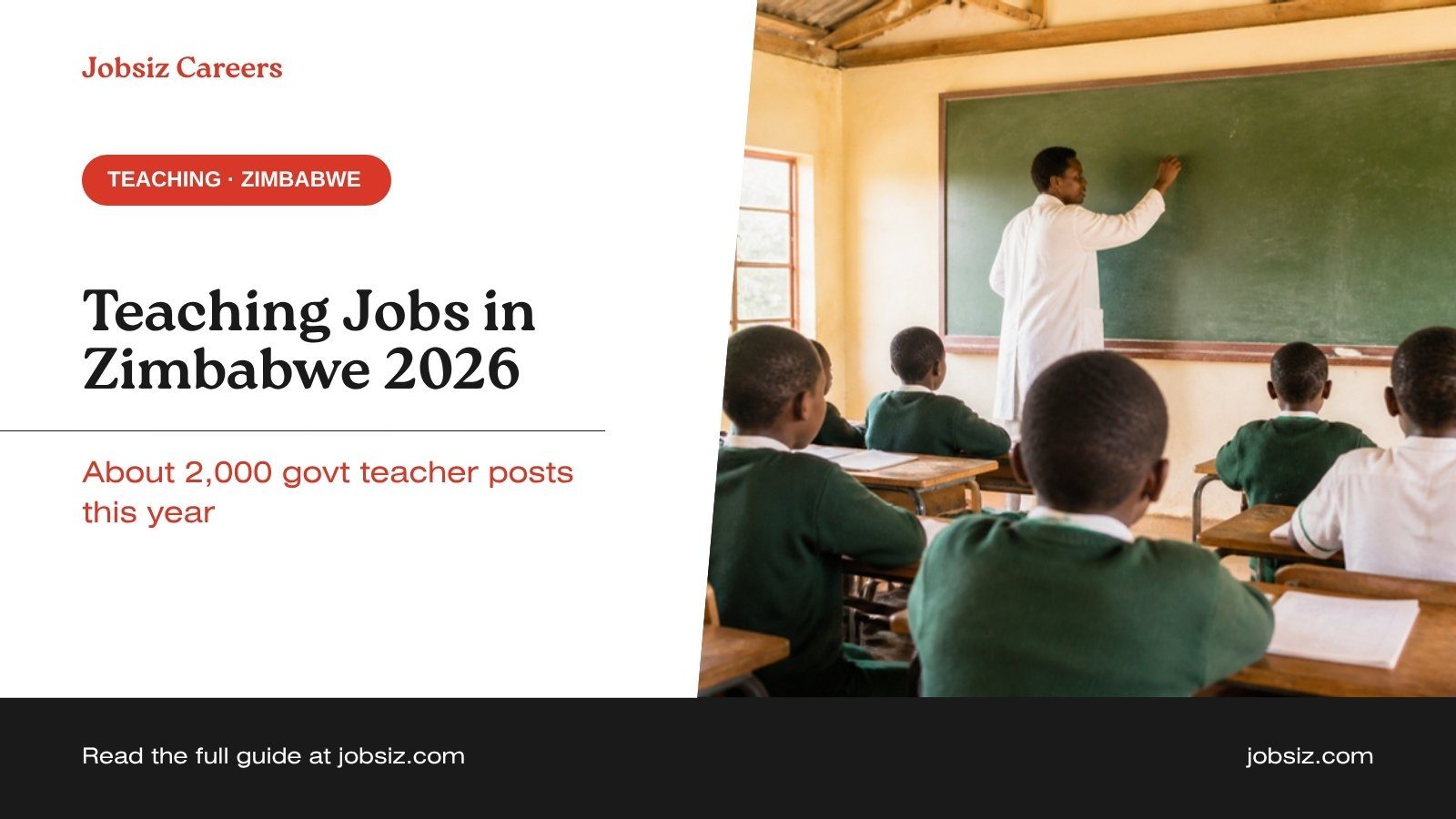
Quick answer: Government teaching jobs in Zimbabwe are filled through the Ministry of Primary and Secondary Education (MoPSE) and the Public Service Commission (PSC), with hiring handled at provincial and district level rather than through one national advert. Posts are limited by Treasury funding — the Public Service Minister told Parliament in 2026 that only about 2,000 teachers would be recruited this year — so qualified teachers should register with the public service database, keep their papers ready at their district education office, and apply to private and mission schools at the same time.
Key takeaways
Government teacher recruitment is decentralised: provincial and district structures pick candidates for vacant posts.
Only around 2,000 new government teacher posts were planned for 2026, according to Public Service Minister Edgar Moyo (NewsDay, May 2026).
The Education Minister said in August 2026 that earlier graduates (for example the 2020 cohort) are prioritised, while Physics, Chemistry and Biology teachers are usually taken on soon after graduating.
Senior and administrative MoPSE posts are advertised on the PSC e-recruitment portal, not ordinary classroom posts.
No genuine government teaching post requires you to pay a fee or a "placement" agent.
How does government teacher recruitment work in Zimbabwe?
Classroom teachers in government schools are civil servants, so their appointment runs through the Public Service Commission together with MoPSE. Since 2023–24 the ministry has pushed recruitment down the chain:
Provincial recruitment committees: a January 2024 ministry circular, reported by The Chronicle, told provincial committees to fill vacancies pro rata across all teaching levels, with posts spread across the eight rural provinces.
District level: in October 2024 Education Minister Torerayi Moyo said recruitment had been decentralised to districts and urged qualified teachers to register on the Public Service database.
Treasury approval: the number of posts depends on funding. Each year the ministry can only fill the posts Treasury has approved, which is why recruitment comes in batches.
In practice, this means your local district schools inspector's office and provincial education office are where you find out when posts open in your area.
How many teachers is the government hiring in 2026?
In May 2026, NewsDay reported that the government planned to recruit only about 2,000 teachers this year. Public Service Minister Edgar Moyo told Parliament that hiring of teachers and other civil servants depends on Treasury allocations and the country's fiscal space. Teachers' unions described the figure as far too small, pointing to classes of more than 60 learners in some schools.
The Education Minister, by contrast, told Parliament in August 2026 that there is no national teacher shortage, citing teacher–pupil ratios of roughly 1:35 to 1:40, while acknowledging gaps in specific subjects. Either way, competition for each funded post is stiff, so preparation matters.
Who gets priority for teaching posts?
Based on what the ministry has said publicly in 2025 and 2026:
Earlier graduates first: the Minister said older cohorts, such as 2020 graduates, are considered before recent ones. Some 2019–2022 graduates are still waiting.
Science specialists: Physics, Chemistry and Biology teachers are generally hired on graduation, and Mathematics and Science posts in rural secondary schools are hard to fill.
Early Childhood Development (ECD): in 2025 the Minister named ECD classes at primary level as a staffing priority.
Willingness to go rural: most vacancies sit in rural provinces. Being open to a remote posting improves your chances.
What qualifications do you need to teach in a government school?
To be appointed as a qualified teacher you need a recognised teaching qualification — a diploma in education from a teachers' college, or a degree combined with a teaching qualification. Your subject specialisation matters, because posts are filled by subject and level (ECD, junior, or secondary).
Before posts open, gather:
Your teaching diploma or degree certificate and academic transcript.
O-Level (and A-Level, if you have it) certificates.
Your national ID and birth certificate.
A short, up-to-date CV listing teaching practice schools and subjects taught (see our CV format guide).
Ask your district office exactly which copies (and whether certified copies) it wants, as practice can vary between districts.
How to apply for a teaching job in Zimbabwe: step by step
Register on the Public Service database. The Minister has specifically asked qualified teachers to do this so they can be picked when posts are funded.
Visit your district education office. Ask how candidates are recorded in your district, which subjects are short, and when the next intake is expected.
Tell them where you can work. Being open to rural districts or hard-to-staff subjects widens your options.
Watch the PSC e-recruitment portal. Senior MoPSE posts — such as deputy director roles advertised in 2026 — are listed at erecruitment.psc.gov.zw. You create an account, complete your profile with qualifications and CV, then apply online.
Apply to non-government schools as well. Private, trust and church-run schools advertise their own vacancies. Browse current teacher jobs in Zimbabwe on Jobsiz.
Keep your papers ready. When a district calls candidates, the turnaround can be short.
What do government teachers earn?
Teachers are paid on the civil service grading structure, in a mix of US dollars and ZiG. For how the pay bands work and how salaries are split between currencies, read our guide to civil servants' salary grades in Zimbabwe.
How to avoid teaching job scams
MoPSE and the PSC do not charge fees to be recruited or deployed. Anyone asking for money to "secure a post" is a red flag.
Be wary of WhatsApp and Facebook adverts promising guaranteed government teaching posts.
Confirm any vacancy with your district or provincial education office, or on the official PSC portal.
Never send copies of your ID or certificates to unverified numbers or email addresses.
What this means for you
With few funded government posts in 2026, treat recruitment as a waiting list you need to be on, not a one-off advert. Register, stay in touch with your district office, be flexible on location, and apply to private and mission schools while you wait. Science and ECD teachers have the strongest prospects. For other public sector openings, see our PSC vacancies Zimbabwe guide and all jobs in Zimbabwe.
Frequently asked questions
How do I apply for a government teaching post in Zimbabwe?
Register on the Public Service database and contact your district education office, which handles recruitment for vacant posts once Treasury approves funding. Senior ministry posts are advertised on the PSC e-recruitment portal.
How many teachers will Zimbabwe recruit in 2026?
About 2,000, according to Public Service Minister Edgar Moyo, as reported by NewsDay in May 2026. The number depends on Treasury funding.
Which teachers are most in demand?
Physics, Chemistry, Biology and Mathematics teachers, especially for rural secondary schools, and Early Childhood Development teachers at primary level.
Do I have to pay to be recruited as a teacher?
No. Government teacher recruitment is free. Report anyone asking for a fee to your district education office.
I graduated recently. Will I be hired soon?
The Minister has said earlier graduates are prioritised, so recent non-science graduates may wait. Register anyway and apply to private and mission schools in the meantime.
Sources
NewsDay — Treasury's 2,000 teacher plan sparks outrage (May 2026)
CITE — Minister on teacher shortages and recruitment priorities (August 2026)
NewsDay — Govt decentralises teachers' recruitment (October 2024)
The Chronicle via Zimbabwe Situation — provincial recruitment and science priority (January 2024)
The Herald via Zimbabwe Situation — ECD and science priorities (May 2025)
Looking for a classroom role now? See the latest teacher vacancies in Zimbabwe on Jobsiz.
By the Jobsiz Editorial Team · Updated 24 October 2026
Spotted an error or out-of-date detail? Report a correction — we review every report. See our editorial policy.