2027 Base Pay in Ghana: Latest on Public Sector Salary Talks
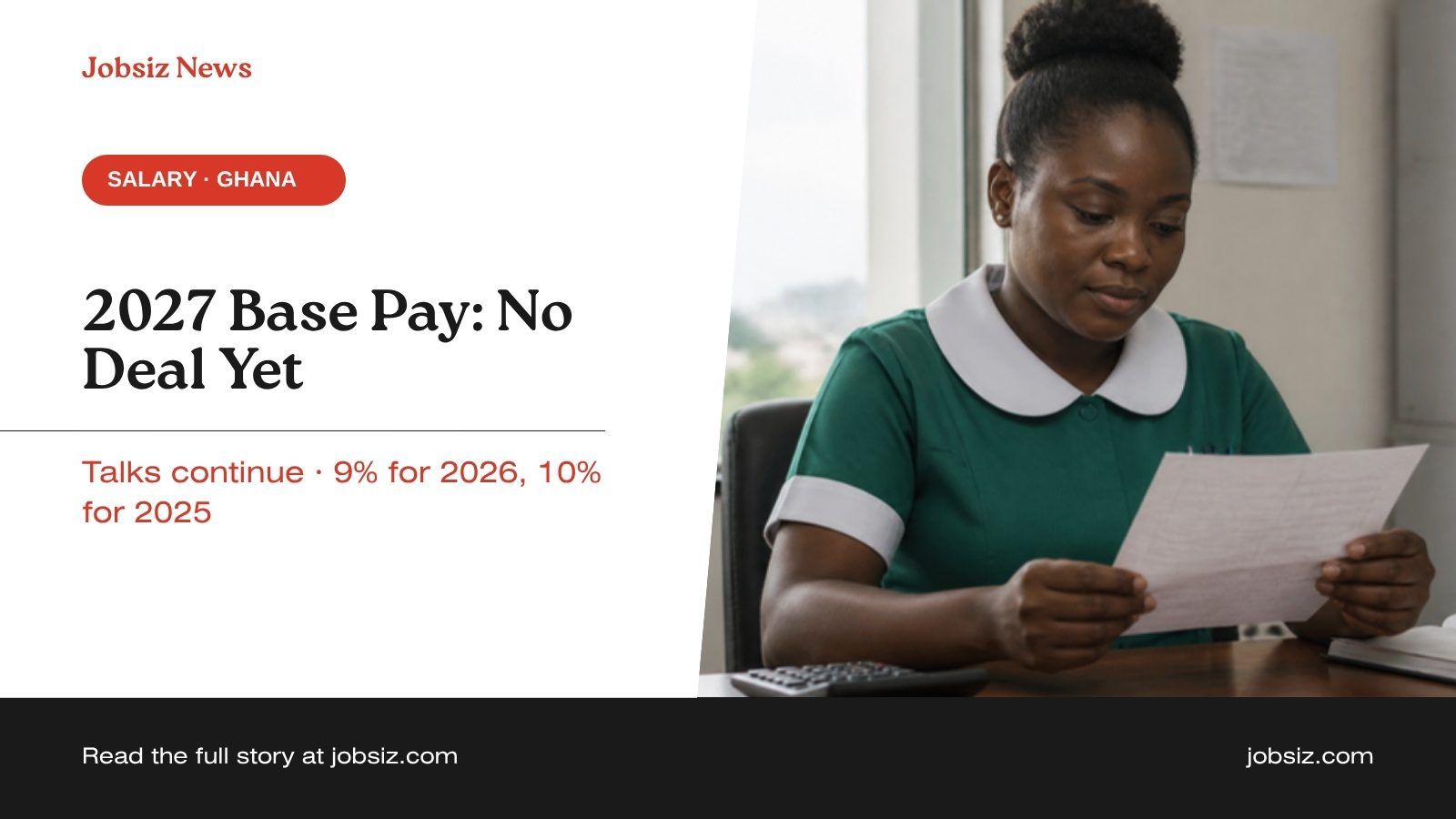
Quick answer: As of 27 October 2026, no 2027 base pay increase has been agreed for Ghana's public sector workers. The Fair Wages and Salaries Commission (FWSC), government and Organised Labour opened talks on 15 October, met again on 22 October without a deal, and are expected to settle a figure before the 2027 Budget goes to Parliament in early November. Claims of a "6% offer" are not official. For comparison, base pay rose 10% for 2025 and 9% for 2026.
2027 base pay at a glance
Status: under negotiation; no agreed percentage yet.
Who negotiates: the Public Services Joint Standing Negotiation Committee (PSJSNC), convened by the FWSC, with government and Organised Labour at the table.
Meetings so far: 15 October 2026 (opening session) and 22 October 2026 (ended without consensus).
Who it affects: public sector workers paid on the Single Spine Salary Structure (SSSS).
Period covered: January to December 2027.
Deadline pressure: the agreed figure is expected to feed into the 2027 Budget, which must be presented by 15 November. The Finance Minister has pointed to the first week of November.
Recent increases: 10% for 2025 and 9% for 2026.
What is base pay and why it matters
Base pay is the reference salary on which the whole Single Spine pay structure is built. Every grade and step sits a fixed distance above it, so when base pay goes up by a percentage, basic salaries across the structure move up by roughly the same percentage. Allowances, overtime and other payments are calculated separately and are not automatically raised by the same amount.
That is why the annual base pay talks are the single most important pay event of the year for teachers, nurses, doctors, civil servants and other workers on the SSSS. It is also different from the national daily minimum wage, which sets the floor for all workers in Ghana, including the private sector. For that, see our guide to the minimum wage in Ghana for 2026.
What has happened in the 2027 talks so far
15 October 2026: the PSJSNC held its first 2027 meeting at the Ghana Employers Association conference hall in Accra. The FWSC said talks would continue the following week.
16–17 October: social media posts claimed government had offered 6%. The FWSC dismissed this, saying no official offer had been communicated.
20 October: FWSC Chief Executive Dr George Smith-Graham invited both sides back for a second session.
22 October: the second session ended without agreement. Talks are due to resume, but no new date had been published at the time of writing.
What each side is arguing
Organised Labour
Labour leaders accept that inflation has slowed but argue that prices of food, utilities and transport remain high and that workers have not recovered lost purchasing power. Ghana Medical Association President Dr Ernest Yorke, speaking for Organised Labour, said the unions would make "a forceful argument" for an upward adjustment. Some worker groups have publicly rejected the idea of a single-digit rise.
Government
Government has not announced a position. The main constraint is cost: the wage bill is one of the largest items in the budget. One published estimate, based on the GH₵81.4 billion set aside for wages and salaries in the 2026 Appropriation Act, puts the cost of each 1% rise at up to about GH₵800 million. The real figure is likely to be lower, because not every public worker is on the Single Spine.
Inflation and the case for a rise
Inflation is central to the talks. The Ghana Statistical Service reported annual inflation of 5.2% in September 2026, up slightly from 5.0% in August. That is far lower than in 2024 and early 2025, which is why a much smaller rise than in previous years is possible. Labour's counter-argument is that a lower inflation rate only slows the pace of price rises; it does not bring prices back down.
For context, the 2026 rise of 9% came after a 10% rise for 2025, a year in which inflation was considerably higher than the pay award.
How a 2027 increase could change your salary
Until a figure is agreed, you can estimate the effect on your own basic salary with a simple calculation: current monthly basic salary × percentage increase. The examples below use an illustrative basic salary of GH₵3,000 a month; they are not official figures.
5% rise: about GH₵150 more a month (GH₵3,150).
7% rise: about GH₵210 more a month (GH₵3,210).
9% rise (same as 2026): about GH₵270 more a month (GH₵3,270).
12% rise: about GH₵360 more a month (GH₵3,360).
These are gross amounts. Your take-home increase will be smaller after SSNIT contributions and income tax (PAYE). Check your latest payslip for your exact basic salary before calculating.
When will workers see the new pay?
The new base pay normally takes effect from January of the year it covers, once government and labour sign the agreement and it is reflected in the budget. In practice, payroll updates are processed centrally, so workers do not need to apply for the increase. If the new rate reaches the payroll after January, ask your employer or union whether arrears will be paid.
To follow the outcome:
Watch for an official statement from the Fair Wages and Salaries Commission.
Check your union's official channels (for example GNAT, NAGRAT, CCT-GH, GRNMA or the GMA).
Look for the base pay figure in the 2027 Budget Statement when it is read in Parliament.
Beware of "salary upgrade" scams
Every year, fraudsters use pay talks to target public workers with messages promising faster salary upgrades, arrears payments or "validation" in exchange for a fee or your bank and payroll details. The base pay increase is applied automatically on the government payroll. Nobody needs to pay "protocol" or "processing" money to receive it. Ignore links and WhatsApp messages that do not come from the FWSC, your employer or your union, and never share your PIN, staff ID password or bank details.
Looking for better-paid work in Ghana?
If you are weighing up a move, browse the latest jobs in Ghana and jobs in Accra on Jobsiz. You may also find our guides to GES teacher recruitment and Ministry of Health recruitment useful.
Frequently asked questions
Has the 2027 base pay increase been announced?
No. As of 27 October 2026, government and Organised Labour had met twice without agreeing a figure. An announcement is expected before or with the 2027 Budget in early November.
Is the 6% base pay offer for 2027 true?
No official 6% offer has been made. The Fair Wages and Salaries Commission said the figure circulating on social media was not an official offer.
How much was the base pay increase for 2026?
Base pay on the Single Spine Salary Structure rose by 9% for January to December 2026, after a 10% increase for 2025.
Does the base pay increase apply to private sector workers?
No. Base pay applies to public sector workers on the Single Spine. Private sector pay is set by employers and collective agreements, subject to the national daily minimum wage.
Do I need to apply to receive the increase?
No. Once agreed, the increase is applied through the government payroll. Anyone asking you to pay a fee to receive it is attempting a scam.
Sources
Ghana News Agency: FWSC begins negotiations on 2027 base pay (17 October 2026)
GBC: FWSC invites government, Organised Labour over 2027 base pay (22 October 2026)
Citi Newsroom: 2027 base pay talks end inconclusively (October 2026)
MyJoyOnline: Organised Labour pushes for higher 2027 base pay (15 October 2026)
Daily Graphic: Public sector workers get 9% salary increment (10 November 2025)
Ghana News Agency: Base of Single Spine Salary Structure up by 10% (20 February 2025)
By the Jobsiz Ghana desk · Updated 27 October 2026. We will update this page when the 2027 base pay figure is confirmed. Spotted an error? Tell us.
Spotted an error or out-of-date detail? Report a correction — we review every report. See our editorial policy.