How to Become a Safari Guide in Botswana: Licence and Jobs
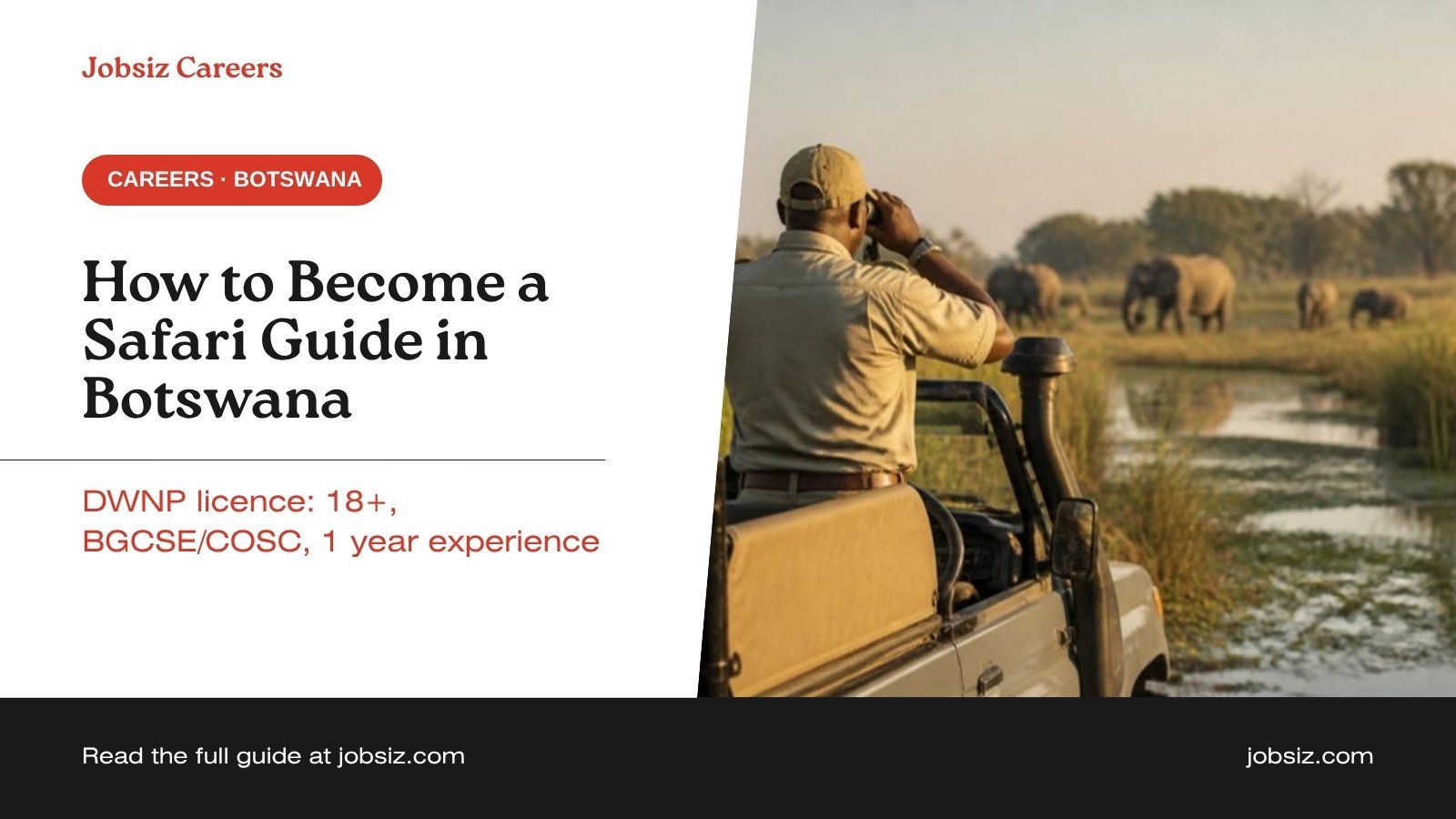
To work as a safari guide in Botswana you need a Professional Guide Licence from the Department of Wildlife and National Parks (DWNP). Citizens must be at least 18, hold a BGCSE or COSC certificate, have one year of related field experience and a valid Class B driver's licence. Shortlisted applicants then sit a theory and a practical exam. The licence lasts one year and processing takes about 48 working days.
This guide covers who qualifies, the documents you need, how training works, and how to find genuine guiding and lodge jobs in the Okavango Delta, Chobe and elsewhere. It also explains how to avoid recruitment scams.
Why guiding is a real career path in Botswana
Tourism is one of Botswana's biggest employers outside government and mining. Statistics Botswana's tourism employment brief, published in August 2025, counted 50,535 people working in tourism industries in the first quarter of 2024. That was 6.7% of everyone employed in the country. Accommodation and food services made up the largest share, at about 34,300 jobs.
Guides are at the centre of the lodge and mobile-safari business. Because every guide must be licensed, lodges cannot staff game drives, walking safaris or mokoro trips without licence holders. That is why operators in Maun, Kasane and the Delta concessions recruit licensed guides every season.
Who can get a Professional Guide Licence?
The government's service page says every guide working in Botswana must hold this licence. The requirement comes from the Wildlife Conservation and National Parks Act. Eligibility differs for citizens and non-citizens.
Citizens
Aged 18 or older
BGCSE or COSC certificate
At least one year of related field experience
Valid driver's licence (Class B)
Non-citizens
Aged 21 or older
Secondary education equivalent to COSC
Valid Class B driver's licence
A valid residence and work permit, or a waiver
Proof of an existing professional guide licence
In practice, most employers recruit Batswana for guiding posts. Foreign nationals also have to go through the separate work-permit process, so it helps to have a firm job offer first.
Documents to prepare
Gather these before the DWNP advertisement comes out, because applications respond to a circulated advert:
Certified copies of your academic and professional certificates
Three professional references, ideally from camp managers or senior guides you have worked under
A certified copy of your valid Omang (citizens) or passport (non-citizens)
Your valid Class B driver's licence
For non-citizens only: certified residence and work permits (or waivers), a CV summarising your career, and proof of an existing guide licence
How to apply: step by step
Watch for the DWNP advertisement. Licence intakes are advertised, so check the official gov.bw service page, the Daily News and DWNP offices regularly.
Write an application letter. Keep it short. State the licence you are applying for and summarise your field experience.
Submit in person or by post. Attach all certified documents and send the application to the Department of Wildlife and National Parks.
Sit the exams if shortlisted. Shortlisted candidates take a theory exam and a practical exam.
Pay the licence fee and collect your licence. Allow around 48 working days for processing.
Renew every year. The licence is valid for one year, so diarise the renewal date.
Fees: the official page lists P1,500 for non-citizens. Citizen fees are shown as P100 and P200, but the page does not make clear which applies to what. Confirm the exact amount with DWNP before you pay, and only pay through official government channels.
Training: how to build the skills employers want
The licence is the legal minimum. Lodges usually also want proof that you know the wildlife, can drive off-road safely and can host guests. There are two main training routes.
Botswana Wildlife Training Institute (BWTI), Maun
BWTI is the government-funded institute under DWNP, on the Thamalakane River near Maun. It runs wildlife management certificates and diplomas, as well as professional guide courses and short courses such as first aid, radio communication and customer service. At its 2019 graduation, all 84 graduates were already employed by DWNP.
BQA-accredited guide qualifications
In 2016, DWNP and the Botswana Qualifications Authority (BQA) introduced a guide qualification delivered through BQA-accredited institutions on the National Qualifications Framework. Guides with workplace experience but no formal qualification can be assessed through recognition of prior learning (RPL). Before you pay for any private course, check on the BQA website that the provider and the qualification are registered.
Skills that get you hired
Identifying mammals, birds, trees and tracks, and explaining animal behaviour
4x4 driving and basic vehicle maintenance in sand and water
First aid, ideally a current certificate
Strong spoken English. Other languages help with international guests
Guest care and storytelling. Tips and repeat bookings depend on this
For mokoro polers: safe water handling. Experienced polers can have their skills formally recognised
Where the guiding jobs are
Okavango Delta concessions: lodges and tented camps, usually reached from Maun
Chobe and Kasane: river cruises, game drives and day trips from Victoria Falls
Moremi, Savuti, Linyanti and the Kalahari pans: mobile and overland safari operators
Training providers and conservation projects: experienced guides can move into instructing or research support
Many new guides start in another lodge role, such as camp hand, barman, waiter or poler. This builds the field experience the licence requires. Because the work is seasonal, expect rotations of several weeks in camp followed by time off.
Browse current openings on the hospitality jobs in Botswana page, or see all jobs in Botswana.
Pay and working conditions
Pay depends on the employer, your experience and the lodge category. There is no reliable public salary scale for guides, so we do not quote one here. Some points still apply to everyone:
Every employee is protected by Botswana's statutory minimum wage. See our Botswana minimum wage 2026 guide.
Guest gratuities can be a significant part of a guide's income, but they are not guaranteed.
Get a written contract that states your rotation, leave, accommodation and meals. Read our explainer on the Employment and Labour Relations Act so you know your rights.
Avoid fake safari job offers
Genuine lodges do not charge a "registration", "training" or "uniform" fee to hire you.
Guide licences come only from DWNP. No agent can "fast-track" one for money.
Be wary of jobs advertised only on WhatsApp or Facebook with no company name, address or website.
Check the operator on its official website, and confirm any course on the BQA register.
Prepare your application
Write a CV that puts field experience, species knowledge and certificates first. Our CV format guide and cover letter examples will help, and the free Jobsiz resume builder makes it quick. If you are still at school or have just finished, our guide to the Botswana internship programme explains another way to gain experience.
Frequently asked questions
Do I need a licence to be a safari guide in Botswana?
Yes. All guides working in Botswana must hold a Professional Guide Licence issued by the Department of Wildlife and National Parks.
What are the minimum requirements for citizens?
You must be at least 18, hold a BGCSE or COSC certificate, have one year of related field experience and hold a valid Class B driver's licence.
How long is the guide licence valid?
One year. You need to renew it annually. A new application takes about 48 working days to process.
Can foreigners work as guides in Botswana?
Non-citizens can apply if they are 21 or older. They need a residence and work permit (or waiver), proof of an existing guide licence and the other listed documents.
Where can I train to become a guide?
You can train at the Botswana Wildlife Training Institute in Maun or with a BQA-accredited training provider. Experienced guides without a qualification can apply for recognition of prior learning.
Sources
Statistics Botswana: Employment in the Tourism Industries, Q1 2024
Tourism Update: Botswana's new system for guide qualifications (2016)
Ready to start? Get your documents certified, watch for the next DWNP advert, and browse lodge and hospitality jobs in Botswana on Jobsiz today.
Spotted an error or out-of-date detail? Report a correction — we review every report. See our editorial policy.