Mining Jobs in Zimbabwe: How to Apply to Zimplats, Mimosa, Unki and More (2026)
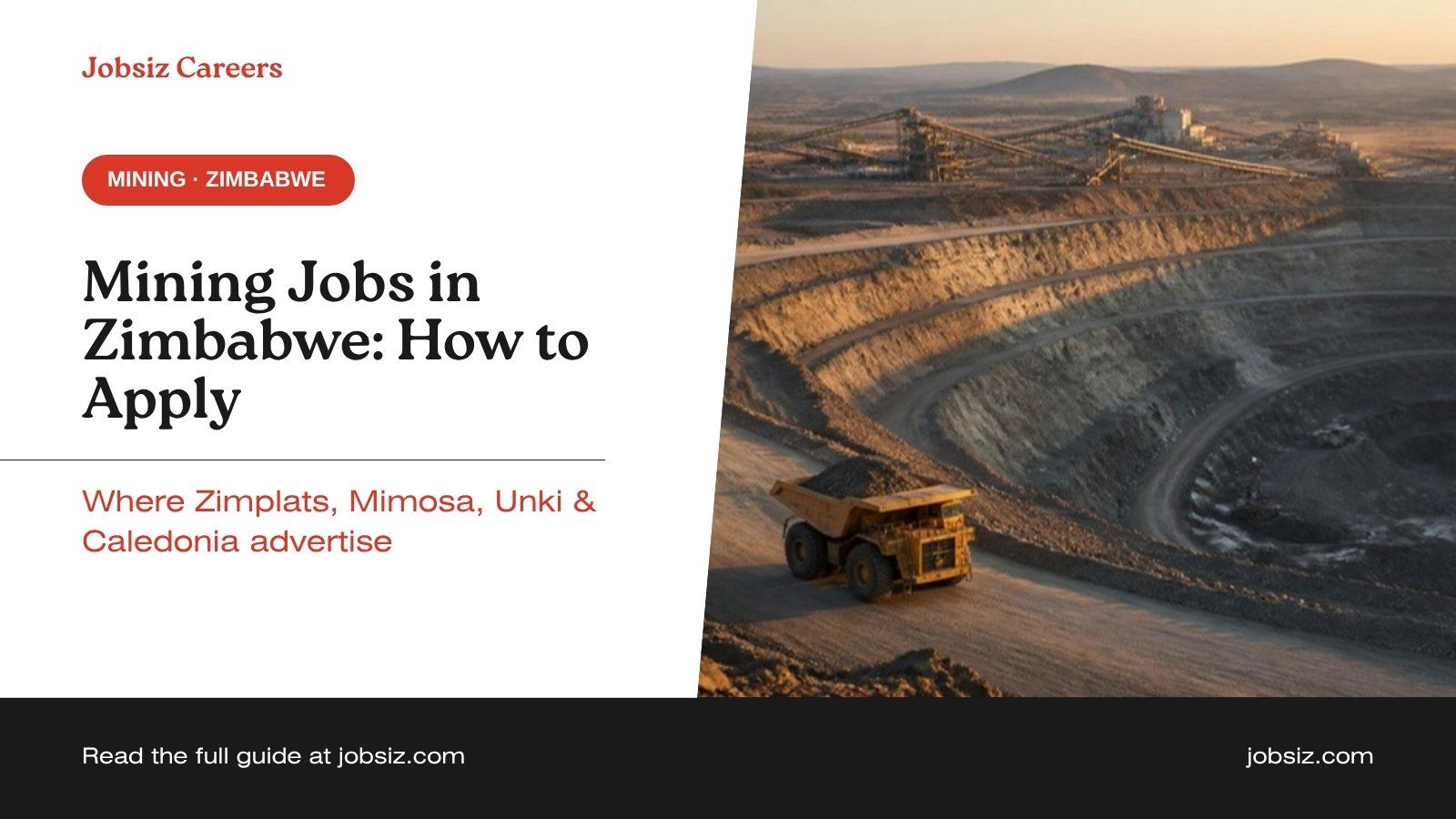
Quick answer: Most mining jobs in Zimbabwe are filled through each mine's own channels: Zimplats posts external vacancies on its official careers page and in national newspapers, Mimosa advertises in "reputable local media", Unki puts local posts on its mine-complex notice boards, and Caledonia (Blanket Mine) says it does not recruit publicly at all. None of these companies charges a fee to apply. Graduates should watch for Zimplats' Graduate Learnership adverts, which the company says it typically runs in January and July.
Mining is one of the few sectors in Zimbabwe that still hires engineers, artisans, metallurgists, geologists and graduates in meaningful numbers. The Chamber of Mines of Zimbabwe's 2025 Annual Report says the industry "formally employs around 60,000 people" and that at least 51,022 mine workers were on record at 31 December 2025. It also notes job losses of 7.8% from retrenchments, so competition for each post is real. This guide explains where the main employers actually advertise, what their trainee schemes ask for, and how to avoid the fake "mine job" adverts that circulate on WhatsApp and Facebook.
Where the big mines advertise (and how they accept applications)
Zimplats (platinum group metals, Ngezi and Selous)
Operations: the Ngezi mines in Mhondoro-Ngezi and the Selous Metallurgical Complex.
Where jobs appear: the Zimplats careers page and national newspapers. Internal posts go up on local notice boards first, aimed at current contract staff and workers employed by Zimplats contractors.
How to apply: genuine adverts tell you to apply through the official HR email address given on the Zimplats website, or by delivering a hard copy to the site offices. Zimplats says it does not use WhatsApp numbers or recruitment agents.
Graduate Learnership Programme: a two-year programme for high-performing university graduates, "ordinarily 25 years of age and below". The disciplines change with each advert. Zimplats says it typically advertises the programme in January and July, subject to availability.
Student internships (industrial attachment): these are not advertised publicly. Zimplats asks universities and colleges directly for candidates through faculty staff, so speak to your department's attachment coordinator.
Mimosa (platinum group metals, Zvishavane)
Operations: the Wedza complex on the Great Dyke near Zvishavane, Midlands Province. Mimosa is jointly owned by Implats and Sibanye-Stillwater.
Where jobs appear: on its careers page, Mimosa says vacancies "are advertised on reputable local media" as and when they arise.
Graduate trainee programme: 24 months of management development for graduates of recognised universities with at least an upper second class degree.
Internships: Mimosa takes tertiary students who need work exposure as part of their undergraduate studies.
Unki (platinum group metals, Shurugwi)
Ownership: Unki now belongs to Valterra Platinum, the business demerged from Anglo American in 2025. Some older articles still call it an Anglo American mine.
Where jobs appear: Unki has previously stated that local vacancies are posted on notice boards at the Unki Mines Complex and are not advertised on social media. Valterra's group roles are listed on its official careers page, which also carries a recruitment-fraud warning.
Caledonia Mining (gold, Blanket Mine near Gwanda)
Operations: Blanket Mine, about 15 km west of Gwanda in Matabeleland South, plus the Bilboes project north of Bulawayo, which is still being developed.
Important: Caledonia's official people page states that the company "DOES NOT recruit staff publicly" and tells the public to ignore emails offering employment. Treat any "Blanket Mine is hiring, send your CV and a fee" message as suspicious.
Other employers worth watching
Karo Platinum: a newer PGM project with large hiring plans. See our separate guide to Karo Platinum vacancies.
Lithium projects (Bikita, Arcadia and others): we could not find official online careers pages for these operations, so be extra careful with adverts that claim to come from them. Check with the mine office before you apply.
Contractors and suppliers: drilling, engineering, security and catering contractors fill many on-site roles. Jobs posted by verified employers appear on our jobs in Zimbabwe page and in the engineering jobs category.
Which mining jobs are in demand?
Advertised mining roles in Zimbabwe usually fall into four groups:
Professional and technical: mining engineers, metallurgists, geologists, surveyors, ventilation officers and SHEQ (safety, health, environment and quality) officers.
Artisans: fitters, electricians, boilermakers, diesel plant fitters and instrument technicians. Adverts often ask for a Class 1 trade certificate or a national diploma.
Operators: drill rig, load-haul-dump (LHD) and plant operators. Many of these posts are filled from the local community.
Support functions: finance, HR, procurement, stores, IT and administration.
How to apply for a mining job in Zimbabwe: step by step
Use official sources only. Bookmark each mine's careers page, buy or check the national newspapers (especially the weekend editions), and ask at the mine's HR office about local notice boards if you live near an operation.
Match the advert exactly. Mining adverts are specific about qualifications, years of experience, certificates (for example a blasting licence or Class 1 trade certificate) and age limits for trainee schemes. Do not apply if you clearly fall short.
Prepare a focused CV. Put safety training, equipment you can operate and production or project results near the top. Our CV format guide shows a clean layout that works for technical roles.
Write a short, specific application letter. Quote the job title and any reference number, and say why you suit that site. See our job application letter templates.
Attach certified copies of your ID, certificates and trade papers only when the advert asks for them, and never send originals.
Submit only through the channel in the advert, whether that's the official HR email, a hard copy at the site office or an official online portal, and before the closing date.
Prepare for assessments. Shortlisted candidates may face aptitude tests, technical interviews and pre-employment medicals.
Training routes into mining
If you do not yet have a mining qualification, the Zimbabwe School of Mines (ZSM) in Bulawayo is the specialist public college for the sector. Its application portal lists diploma and higher-diploma programmes including Mining Engineering, Metallurgical Engineering and Assaying, Mining Geology and Mine Surveying. It also lists certificates such as Mine Occupational Health, Safety and Environment and Small-Scale Mining. Check the portal or call the school for current intake dates and entry requirements before you pay any fees.
University graduates in mining, metallurgical, mechanical, electrical, chemical or geology fields should target the graduate schemes above. Current students should ask their faculty about industrial attachment placements, because Zimplats says it recruits interns through institutions rather than public adverts.
How to spot fake mining job adverts
Fake adverts using mine names and logos circulate regularly. Zimplats has warned that "scammers often copy or manipulate logos", so a logo alone proves nothing. Red flags include:
Any request for money: "registration", "medical", "training" or "processing" fees. Zimplats, Valterra and other major employers say they never charge applicants.
WhatsApp-only contacts, or Gmail and Yahoo addresses instead of company domains.
Urgent wording ("only 24 hours left"), poor grammar, or promises of a job without an interview.
Adverts for employers that say they do not recruit publicly, such as Caledonia.
If in doubt, phone the mine's main switchboard or check its official website before you send anything. For more on fake job offers, see our report on Zimbabwe's planned law against fake overseas jobs.
Frequently asked questions
Do mines in Zimbabwe charge application fees?
No. Zimplats states that it does not request payment at any stage of recruitment, and Valterra Platinum (Unki's parent) also warns about recruitment fraud. Anyone asking for money to secure a mine job is very likely a scammer.
When does Zimplats open its graduate programme?
Zimplats says it typically advertises Graduate Learnership Programme positions in January and July each year, subject to availability. Applicants are ordinarily 25 or younger. Watch the careers page and national newspapers around those months.
How do I get industrial attachment at a Zimbabwean mine?
Speak to your university or college. Zimplats, for example, does not advertise internships publicly and asks institutions directly for student candidates. Mimosa also offers internships to tertiary students who need work experience for their studies.
Does Blanket Mine (Caledonia) advertise jobs online?
No. Caledonia's official website says the company does not recruit staff publicly and asks people to ignore emails about employment opportunities.
How many people work in Zimbabwe's mining industry?
The Chamber of Mines of Zimbabwe's 2025 Annual Report says the industry formally employs around 60,000 people. Its labour section records at least 51,022 workers as at 31 December 2025.
Find mining and engineering jobs on Jobsiz
Ready to apply? Browse the latest jobs in Zimbabwe and jobs in Harare, and tidy up your application with our cover letter examples. Always confirm an advert on the employer's own website before you apply.
Sources
By the Jobsiz Editorial Team. Last updated 21 October 2026. Recruitment processes can change, so always check the employer's official channels.
Spotted an error or out-of-date detail? Report a correction — we review every report. See our editorial policy.