Safari Lodge Jobs in Botswana: Roles, Pay and How to Get Hired
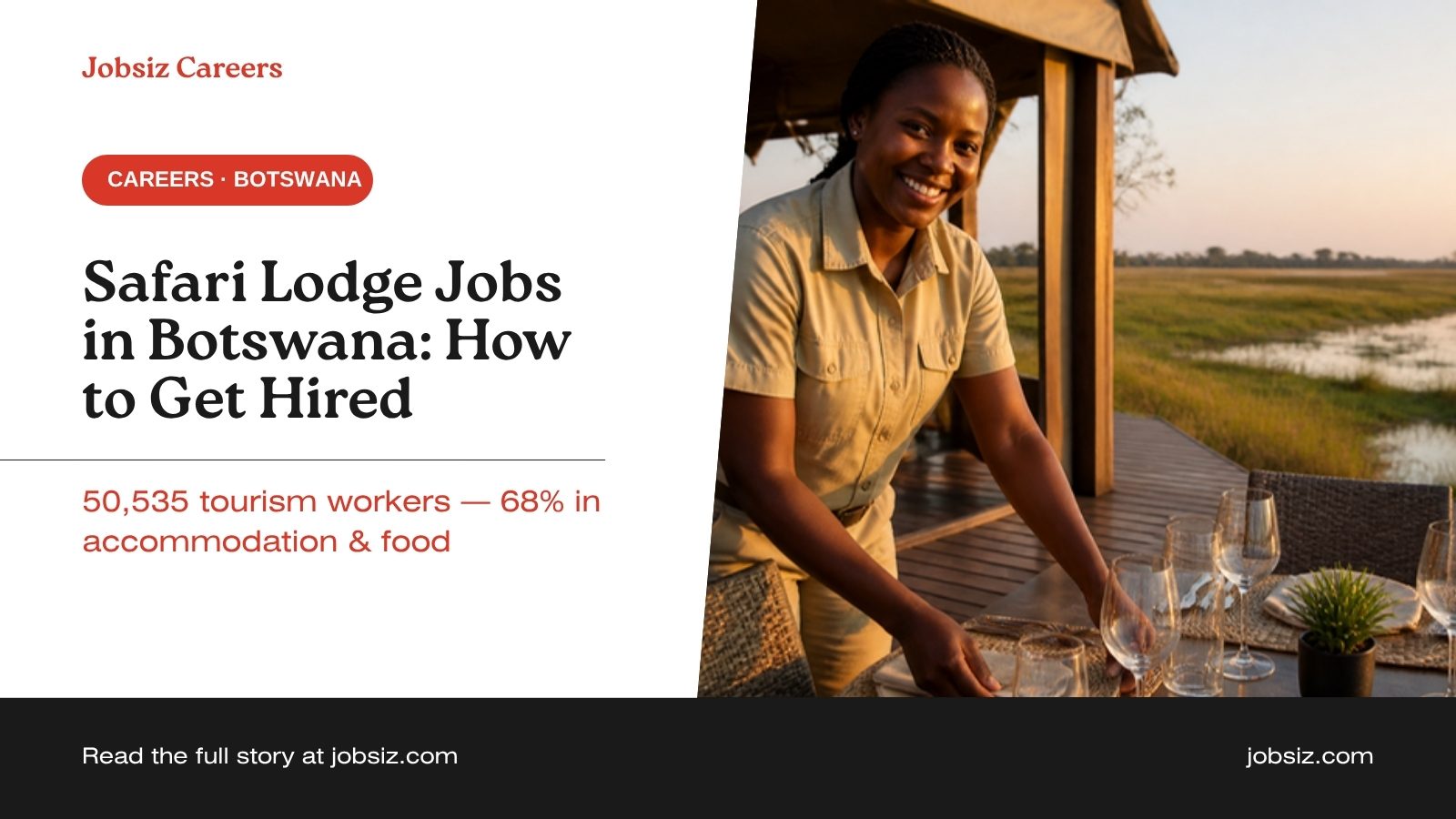
To get a safari lodge job in Botswana, start with an entry-level camp role (housekeeping, waitering, kitchen, maintenance or camp hand), apply directly through the official careers pages of established safari operators or through vacancies on trusted job boards, and build skills in guest service, cooking or front office along the way. Tourism is a sizeable employer: Statistics Botswana estimates that 50,535 people worked in tourism-related industries in 2024, and about two in three of them worked in accommodation and food services. This guide explains which lodge jobs exist, what they pay on average, and how to apply safely.
How many people work in Botswana's tourism and lodge sector?
The first official snapshot of tourism employment, the Employment in the Tourism Industries Stats Brief, 2024 published by Statistics Botswana in August 2025, gives a useful picture of the sector:
50,535 people were employed in tourism-related industries in 2024, which is 6.7% of Botswana's 754,147 employed people.
Accommodation and food services (lodges, hotels, camps, restaurants) accounted for 67.9% of those jobs, or roughly 34,300 workers.
The largest age group was 25 to 29 years (21.3%), so it is a sector where young people can get a foothold.
Most tourism workers (58.7%) had secondary education as their highest level, and 18.3% had a tertiary qualification. In other words, a degree is not a requirement for most lodge jobs.
Government also wants the sector to grow. Speaking at the HATAB conference in Maun in April 2026, the Minister of Environment and Tourism, Wynter Mmolotsi, said the target is 5,000 additional tourism jobs by 2030, as reported by Mmegi.
Which jobs are available at safari lodges and camps?
A remote camp in the Okavango Delta or a lodge in Chobe runs like a small hotel, so it needs a full team. Common roles include:
Housekeeping and laundry: preparing tents and rooms, laundry and keeping public areas clean. Often the most common entry point.
Food and beverage: waiters, barmen and barladies, and hosts who look after guests at meals and sundowners.
Kitchen: kitchen assistants, cooks, pastry cooks and chefs. Experienced chefs who can cook for small, demanding groups are valued.
Maintenance and camp hands: general maintenance, plumbing, electrics, solar and water systems, vehicle care and grounds.
Front office and reservations: check-in, guest relations and bookings, usually at larger lodges or in head offices in Maun, Kasane or Gaborone.
Guiding: game drive, walking and mokoro guides. This needs a licence from the Department of Wildlife and National Parks; see our separate guide on how to become a safari guide in Botswana.
Supervision and management: camp managers, assistant managers, head chefs and operations managers. These roles are usually filled by people who have worked their way up through camp jobs.
How much do lodge and hospitality workers earn in Botswana?
There is no single public salary scale for private lodges, and pay varies by employer, location and role. The best official guide is the Statistics Botswana brief, which reports average monthly cash earnings for wage earners in tourism-related industries (survey data from the first quarter of 2024):
All tourism workers: about P3,259 a month on average.
Accommodation and food services: about P2,947 a month on average (P3,000 for women and P2,871 for men).
Accommodation and food services in cities and towns: about P3,791 a month on average.
Managers: about P12,947 a month, the highest of any occupational group.
Elementary occupations (such as cleaners and general hands): about P1,936 a month, the lowest.
Keep in mind that these are averages, not offers. Some camp jobs also include accommodation and meals on site, which affects the value of the package, so ask what is included before you compare offers. Your employer must still respect any minimum wage that applies; see our Botswana minimum wage guide and our explainer on the Employment and Labour Relations Act for your basic rights.
What qualifications and skills do lodges look for?
For most entry-level camp jobs, employers look for attitude and reliability more than certificates. Things that help your application:
BGCSE or equivalent and good spoken English, because you will deal with international guests every day.
Hospitality training, such as a certificate or diploma in hospitality, food production or tourism from an institution with qualifications registered by the Botswana Qualifications Authority (BQA).
Hands-on experience in a hotel, guesthouse, restaurant or catering business, even part-time.
Practical skills such as a driver's licence, basic first aid, cooking or trade skills for maintenance roles.
Willingness to live remotely. Many camps are only reachable by small plane, boat or 4x4, and staff often work long shifts with rotations of several weeks in camp followed by time off.
How to apply for safari lodge jobs in Botswana: step by step
Choose your starting role. Pick one or two roles that match your skills (for example housekeeping and waitering) rather than applying for everything.
Prepare a short, clear CV. List hospitality experience first, plus languages, licences and any training. Our CV format guide and free resume builder can help.
Get certified copies of your documents ready: Omang, certificates and references, so you can respond quickly when a vacancy opens.
Apply through official channels. Larger safari companies post vacancies on their own careers pages; for example, Wilderness links to its vacancies from its official careers page. You can also browse hospitality jobs in Botswana and all jobs in Botswana on Jobsiz.
Write a tailored cover letter. Explain why you want to work in a remote camp and give one example of excellent guest service. See our cover letter examples.
Look in tourism hubs. Maun and Kasane are the main bases for many Okavango and Chobe operators, so local adverts, notice boards and head offices there are worth checking.
Follow up once. If you have not heard back after about two weeks, a short, polite follow-up email is fine.
How to avoid fake lodge job offers
Safari and lodge jobs are popular, which makes them a target for scammers. Protect yourself:
Never pay a fee to apply, to be shortlisted, for "training", for uniforms or for a "placement". Genuine employers do not charge applicants.
Check the employer. Confirm the vacancy on the company's official website or by calling its known office number, not the number in a suspicious advert.
Be wary of WhatsApp-only adverts that promise high pay with no interview, or ask for your Omang and bank details up front.
Insist on a written contract that states your pay, hours, rotation, leave and what accommodation and meals are provided.
What this means for you
Lodge work is one of the most realistic ways into Botswana's tourism industry without a degree. Start in an entry-level camp role, learn fast, and use the experience to move into chef, guiding, front office or management roles. Keep your documents ready, apply only through official channels, and never pay to get a job.
Ready to start? Browse the latest hospitality jobs in Botswana and entry-level jobs on Jobsiz.
Frequently asked questions
Do I need a degree to work at a safari lodge in Botswana?
No. Most tourism workers in Botswana have secondary education as their highest qualification, according to Statistics Botswana. A hospitality certificate and practical experience help, but many people start in housekeeping, waitering or kitchen roles.
How much does a lodge worker earn in Botswana?
Statistics Botswana reports average monthly cash earnings of about P2,947 in accommodation and food services (Q1 2024 survey data). Managers in tourism industries averaged about P12,947. Actual pay depends on the employer, role and whether accommodation and meals are included.
Where are most safari lodge jobs in Botswana?
Mainly in and around the Okavango Delta and Moremi (with Maun as the hub) and the Chobe area (with Kasane as the hub), plus lodges in the Kalahari and the Linyanti region.
Do I have to pay to get a lodge job?
No. Legitimate employers do not charge application, shortlisting or training fees. If someone asks for money, treat it as a scam and report it.
Do I need a licence to be a safari guide?
Yes. Guides need a Professional Guide Licence from the Department of Wildlife and National Parks. Our guide on becoming a safari guide in Botswana explains the process.
Sources
Statistics Botswana – Employment in the Tourism Industries Stats Brief, 2024 (August 2025)
Mmegi – Botswana sets ambitious tourism targets to drive sector growth (April 2026)
By the Jobsiz Editorial Team · Updated 25 October 2026
Spotted an error or out-of-date detail? Report a correction — we review every report. See our editorial policy.